Lately, I have found myself being a bit more introspective—and don’t get me wrong, I have always been introspective while pondering the meaning of existence and everything in-between. I am what you would call a citizen physicist or scientist with a very deep interest in virtually everything: math, science, technology, and philosophy, including deep Eastern thought and much more.
So much interest, in fact, that I have spent years studying on MIT OpenCourseWare (This on top of my education background) and authoring unpublished papers on many topics, ranging from physics to advanced mathematics, philosophy, and beyond. Now, you might be asking: what does this have to do with finance or business-related topics? Well, not that much in a literal sense, but it has led me to write somewhat of an inspirational article today and provide some insight into the “why.”
While my head is often in the clouds of theoretical physics, economics or deep philosophy, these disciplines have taught me one thing: every complex system, including our finances, is governed by universal laws. To move through the ‘darkness’ of debt, we have to stop viewing it as a moral failure and start viewing it as a series of variables we have the power to solve.
Let me guess. You woke up this morning and the first thing that hit you — before you even reached for your phone — was that familiar knot in your stomach. Bills. Debt. A bank balance that makes you want to close the app immediately. Maybe it’s been weeks of this. Maybe it’s been years.
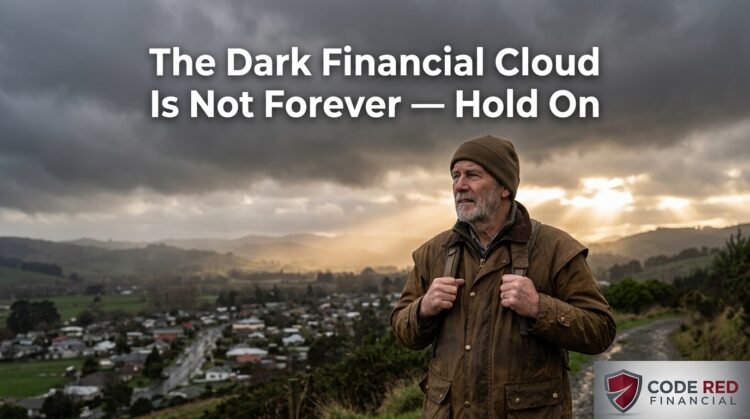
If that’s you right now, I want you to hear something clearly: the dark financial cloud you’re living under is not permanent. It feels like it is. I know it does. But it isn’t. And in this post, I’m going to show you exactly why — and more importantly, how to start moving through it.
Why Financial Hardship Feels So Suffocating
There’s a reason money stress hits differently than other kinds of stress. It’s not just about numbers on a screen. Financial hardship touches everything — your sleep, your relationships, your sense of self-worth. Studies consistently show that financial stress is one of the leading causes of anxiety and depression, and it’s easy to see why.
When you’re struggling financially, it can feel like every door is locked. You can’t invest for the future because you’re barely surviving the present. You can’t enjoy small pleasures without guilt. You can’t stop comparing yourself to people who seem to have it all figured out.
But here’s the truth that most personal finance content skips over: almost everyone who has ever built financial stability has walked through some version of your darkness first. The entrepreneur who now runs a seven-figure business? She once couldn’t make rent. The couple who retired early? They spent their 30s drowning in credit card debt.
Your story is not over. You’re just in a difficult chapter.
The Biggest Mistake People Make When Finances Get Dark
When financial stress peaks, the most natural response is to go into avoidance mode. You stop opening the mail. You ignore the notifications. You tell yourself you’ll deal with it “next week” — but next week comes and the pile just gets heavier.
Avoidance is completely understandable, but it’s one of the most financially damaging habits you can develop. Here’s why: debt doesn’t stay still. Interest accrues. Late fees stack up. What started as a $2,000 credit card balance can quietly balloon into $4,000 while you looked the other way.
The first act of courage when you’re in financial darkness is simply to look. Open the statements. Log into the accounts. Write the numbers down. Yes, it will be uncomfortable. But you cannot navigate out of a storm with your eyes closed.
Hold On — Here’s What Changes When You Stay in the Game
One of the most powerful forces in personal finance is one you’ve probably heard of but may not have truly felt yet: time. Not time as in “wait and hope things get better,” but time as in intentional, consistent effort over a sustained period.
Consider this: someone who starts paying an extra $100 per month toward a $15,000 debt doesn’t just pay it off faster — they can save thousands in interest and reclaim their financial freedom years ahead of schedule. That’s not magic. That’s just staying in the game.
Here’s what “holding on” actually looks like in practical terms:
Stop the bleeding first. Before you can climb out, you need to stop sinking deeper. That means identifying your essential expenses — housing, food, utilities, transportation — and ruthlessly cutting everything else, at least temporarily. This is not punishment. This is triage.
Build your smallest emergency fund possible. Even $500 to $1,000 set aside in a separate savings account acts as a psychological and financial buffer. When the car breaks down or the dentist bill arrives, you don’t have to reach for the credit card. This tiny cushion changes everything about how you interact with money.
Focus on one debt at a time. The debt snowball method — paying off your smallest debt first while making minimum payments on the rest — works not because it’s mathematically perfect, but because it works emotionally. Paying off that first balance gives you a win. Wins build momentum. Momentum is what carries you through the dark.
Talk to someone. Whether it’s a nonprofit credit counselor, a trusted friend, or a licensed financial advisor, you don’t have to solve this alone. There is no shame in asking for help with money. None. The shame culture around financial struggle is one of the cruelest myths in personal finance, and it keeps too many people isolated precisely when they need support most.
Small Signs the Cloud Is Lifting (And How to Recognize Them)
Progress in personal finance is often invisible until suddenly it isn’t. You won’t wake up one morning and feel rich. Recovery is quiet and incremental. But there are real signs that your financial weather is beginning to shift, and learning to recognize them matters.
Your credit score ticks up by 15 points. You go a full month without an overdraft. You actually have money left in your checking account on the 28th. You pay a bill without dreading it. These are not small things — they are evidence that the work is working.
Celebrate these moments loudly and without apology. Most personal finance content is so focused on the destination — financial independence, retirement, wealth — that it completely dismisses the significance of surviving the journey. But surviving is significant. Grinding through is significant. Every month you hold on is a month that compounds in your favor.
What Financial Recovery Actually Looks Like
Let’s be honest about something: recovery is rarely a straight line. There will be setbacks. An unexpected medical bill. A job loss. A car that decides to die at the worst possible time. These things don’t mean you’ve failed. They mean you’re human and that life is unpredictable.
What separates people who ultimately achieve financial stability from those who don’t is not that they avoid setbacks. It’s that they develop the resilience to absorb the blow and keep moving forward. Every setback is a data point, not a verdict.
If you’re in the thick of it right now, here are a few reframes that might help:
- Struggling financially does not make you irresponsible. Life is expensive, wages have stagnated, and the system is genuinely hard to navigate.
- Comparing your Chapter 3 to someone else’s Chapter 20 is a trap. Everyone’s financial timeline is different.
- Progress that feels invisible is still progress. The seed underground doesn’t look like a tree yet, but it’s growing.
Your Action Plan Starts Today
You don’t need a windfall. You don’t need a perfect income or a spotless financial history. You need one step. Just one.
Here’s your starting point: today, get honest about the numbers. Sit down for 30 minutes, open every account, and write down exactly what you owe and what you earn. No judgment. Just data. That single act of financial courage is the beginning of everything.
From there, come back here. Read more. Ask questions. Use the tools and resources on this site. Build your knowledge piece by piece, because financial literacy is one of the most powerful investments you will ever make in yourself — and unlike the stock market, it never goes down.
The Cloud Breaks. It Always Does.
Financial storms do not last forever. Not the debt storm. Not the income drought. Not the “I don’t know how I’m going to make it this month” storm. They break. They always do — especially for the people who refuse to quit.
So hold on. Keep going. And know that every single step you take toward financial health, no matter how small it looks, is moving you closer to the other side of that cloud.
The sun is still there. It hasn’t gone anywhere. You just can’t see it yet.
Was this article helpful? Share it with someone who might be going through a tough financial season. And if you’re ready to take that first step, explore our tools and guides to start building your way forward — one smart decision at a time.
Disclaimer: This article is for informational purposes only and does not constitute financial or investment advice. Consult with a qualified financial advisor or tax professional before making any decisions about your investments or retirement accounts.
Jay Sadio, MBA