
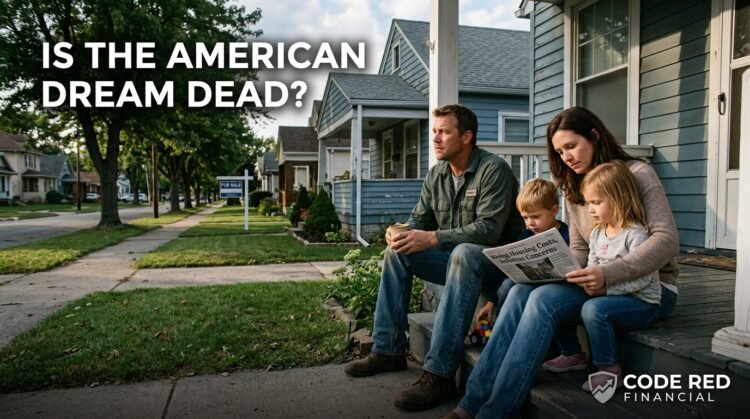
This topic has been sitting on my mind for quite some time.
Months ago, I was having a discussion with old work colleague, now working in the healthcare space, makes decent money, I think $75,000 a year, decent right. He’s been saving for three years to buy a house. Three years of packing lunch, canceling subscriptions, skipping vacations. You know what he has? Enough for a down payment on a starter home in his city. You know what happened when he started looking? Every house in his price range had multiple offers on it within 48 hours. He lost out in a bidding war and simply decided to keep renting for the time being.
His question to me was: “Is it even possible anymore?”
I didn’t have a clear answer for him at the time. And honestly, that bothered me enough to sit down and actually dig into it. So, here’s what I found — no sugarcoating, “here are some of the things I discovered.
Let’s Talk About What the Dream Actually Was
People throw around “the American Dream” like everyone agrees on what it means. They don’t. But the version most of us inherited from our parents goes something like this: work hard, get a steady job, buy a house, raise a family, retire at 65. Maybe not rich, but comfortable. Stable. Better off than where you started.
And here’s the fact — that wasn’t some fairy tale for most of the 20th century. In the 1950s and 60s, a factory worker with a high school diploma could genuinely own a home, support a family on one income, and retire with a pension. That was real. Not for everyone — systemic racism and inequality kept that door shut for a lot of people — but as a broad economic reality, it existed.
So when people say the American Dream is dead, what they’re really grieving is that specific version of it. And honestly? That version has been on life support for quite some time.
The Numbers That Keep Me Up at Night
I’m a numbers person and that is where I typically start my analysis. So let me just lay some out, because I think we’ve gotten numb to how wild this stuff actually is.
The median home price in the US right now is over $430,000. In 1985, it was around $80,000. Even adjusting for inflation, that’s not a wash — home prices have outpaced inflation by a mile. Meanwhile wages? The average worker’s real purchasing power has barely budged since the 1970s. Think about that. Fifty years of “growth” and most workers are roughly treading water.
Or look at college. Tuition has jumped over 180% since 1980, adjusted for inflation. The pitch was always “get a degree and you’ll earn more.” And yeah, the wage premium for a degree still exists — but it’s shrinking in a lot of fields, while the debt you carry to earn that premium has exploded. The average graduate walks out with around $37,000 in student loans. That’s not a head start. That’s a hole you’re climbing out of. And to top it off, recent college graduates are not having the smoothest time landing a decent job or a job for that matter, due in part to a structural shift in the economy with some of that attributed to Artificial Intelligence (AI).
And retirement. Don’t get me started. The average American in their 60s has less than $200,000 saved. Social Security pays roughly $1,800 a month. You do that math. That’s not retirement. That’s survival, maybe, if you own your home outright and have no major health issues. Which, statistically, a lot of people don’t.
Here’s the Part Nobody Wants to Say Out Loud
Hard work used to be enough. It isn’t anymore. Not on its own.
I know that’s uncomfortable. We’re raised on stories of grit and bootstrapping, and those stories still feel true because we personally know people who worked their tails off and made it. But for every one of those stories, there are thousands of people who worked just as hard — harder, even — and are still one medical bill away from financial disaster.
A full-time minimum wage worker in most American cities cannot afford a one-bedroom apartment. That’s not a personal finance problem. That’s a structural one. And pretending it’s just about skipping avocado toast or being more disciplined is insulting to people who are genuinely grinding and still falling behind.
The wealth gap is real and it’s widening. Back in the 1970s, the richest 10% of Americans held about 10 times more wealth than the bottom 50%. Today that ratio is closer to 40 to one. The reason isn’t that rich people got smarter or worked harder. It’s that they own assets — homes, stocks, businesses — that compound. And if you don’t own assets, you’re not in the compounding game.

So Why Do Some People Still Make It?
This is where it gets complicated, and I want to be careful not to turn this into a doom spiral. Because people do still build wealth. People do still buy houses and start businesses and hit financial independence in their 40s. It’s not impossible. But when you look at who’s doing it, patterns emerge.
A lot of them had a leg up — parents who helped with a down payment, a college education they didn’t take on massive debt for, a network that got them the right job. That’s not a character flaw. It’s just the reality of how opportunity moves in this country. It tends to follow existing advantage.
The ones without that starting point who still make it? They’re usually doing something non-linear. They’re starting a business, or picking up a high-income skill and grinding until they’re in the top 20% of earners in their field, or moving somewhere cheaper and refusing to lifestyle inflate. They’re playing a different game than their parents played. And they had to figure that out mostly on their own.
What I Actually Tell People Now
When someone like my old co-worker have questions regarding if the “dream” is still possible. I’ve stopped giving the standard “just keep saving, it’ll work out” line. Because sometimes that’s not enough and they deserve honesty.
Your income is your biggest lever. Not your budget. Cutting expenses has a floor — you can only cut so much before you’re miserable. But income has no ceiling. Whatever it takes — a new skill, a career pivot, a side hustle that you actually monetize instead of just dabble in — getting your income up is the move that changes your trajectory faster than anything else.
Stop sitting in cash. I get it, the market feels scary and a savings account feels safe. But inflation eats cash. The people building wealth are invested in assets. Even boring index funds. You don’t need to be a stock picker. You just need to be in the game.
Geography is an underrated weapon. If you can work remotely, where you live is a financial decision. Someone making $90,000 in Austin lives a fundamentally different financial life than someone making $90,000 in San Francisco. Same salary, completely different runway.
Think in assets, not just income. A paycheck is great. An asset that generates income while you sleep is wealth. The shift from “how do I earn more” to “what do I own” is the mindset difference between people who get ahead and people who stay on the treadmill.

So, Is It Dead?
Here’s where I land on this after all of it.
The version of the American Dream where you just show up, put in your time, and get rewarded with stability and comfort — yeah, that’s mostly gone. The economy isn’t set up that way anymore, and no amount of personal motivation is going to change the structural math.
But the deeper version — the idea that where you start doesn’t have to be where you end up, that you can build something real through smart decisions and relentless effort — that’s still alive. It’s just harder to access than it should be, and it requires a completely different playbook than the one our parents used.
I have not spoken to my old friend in a while, but my guess is that his sight is still set on purchasing a house in the near future and last we spoke, he was working my over-time and added side gigs and stacking that money separately. Like many of us, he is frustrated with the system but as we all now, frustration can be a motivator, but it is not a solution.
That’s kind of the whole thing, isn’t it. The dream didn’t die. It just got a lot more demanding about who’s willing to chase it differently.
What’s your experience been? Are you feeling the squeeze, or have you found a way through? Drop it in the comments — I read every single one.
Disclaimer: This article is for informational purposes only and does not constitute financial or investment advice. Consult with a qualified financial advisor or tax professional before making any decisions about your investments or retirement accounts.
Jay Sadio, MBA