
If you’ve spent more than five minutes on financial Twitter, YouTube, or TikTok recently, you’ve seen the screenshots. Some 22-year-old guru with a rented Lamborghini is claiming they just made a 1,200% return before their morning coffee. They didn’t buy a stock and wait ten years. They didn’t analyze a corporate balance sheet. They clicked a button on their phone, rode a massive spike in the market, and cashed out with life-changing money in under thirty minutes.
They did it using something called 0DTE Options.
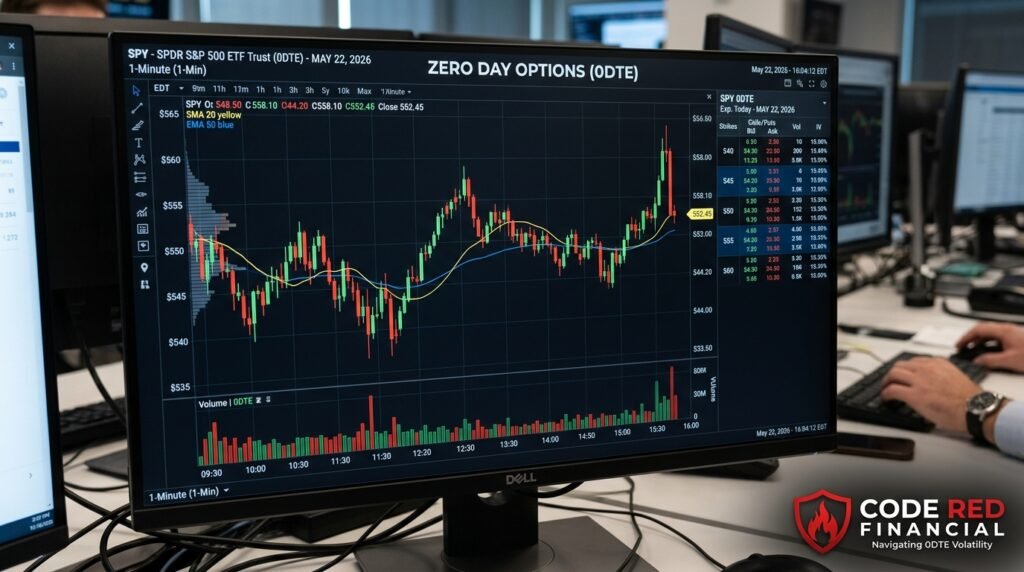
0DTE stands for Zero Days to Expiration. These are options contracts that expire at the closing bell on the exact same day you buy them. In the past, these were obscure instruments used mostly by institutional funds to hedge massive portfolios against last-minute market crashes. Today? Wall Street has weaponized them for the retail market. In a recent interview on CNBC, Warren Buffett, the Oracle of Omaha, sharply criticized zero‑day options (0DTE) — contracts that expire within 24 hours — calling them “pure gambling” and warning that the market’s speculative mood has never been stronger.
Currently, 0DTE contracts account for nearly half of all options volume on the S&P 500. Wall Street brokers market them as the ultimate tool for “agile traders” looking to capitalize on daily market movements. Retail investors, desperate to beat inflation and get rich quick, treat them like a digital slot machine.
As usual, I am going to eliminate the marketing noise and answer the question everyone is actually asking: Is trading single-day options just gambling?
The short answer is yes. If you are blindly buying a 0DTE call option because you have a “gut feeling” the market is going to go up today, you are gambling. You are sitting at Wall Street’s blackjack table, and the house has a mathematical edge that will eventually bleed your account to absolute zero.
But if you understand the brutal, unforgiving mechanics of how these contracts are priced, they stop being lottery tickets and start being highly tactical, surgical tools. If you want to step into the 0DTE arena without getting slaughtered by the market makers, you need to stop acting like a tourist at a casino.
Here is the “Code Red” investigator’s guide to the mechanics, the traps, and the actual rules for trading 0DTE options.
1. The House Advantage: Why You Are Designed to Lose
To understand why 0DTE options are so dangerous, you have to understand the fundamental difference between investing and trading options.
When you buy a share of a stock like Apple or an S&P 500 ETF, time is on your side. If the stock goes down today, you can simply hold it until tomorrow, or next month, or next year. You own a piece of a cash-flowing asset.
When you buy an options contract, you are buying a ticking time bomb. An option is simply a contract that gives you the right to buy or sell a stock at a specific price (the strike price) by a specific date (the expiration).
Options prices are derived from two things:
- Intrinsic Value: Is the option currently “in the money”?
- Time Value: How much time is left for the stock to make a wild move before the contract expires?
When you buy a 0DTE option, there is zero runway. The “time value” is evaporating at lightspeed. You do not just have to be right about the direction of the stock. You have to be right about the exact minute it moves, the velocity of the move, and the magnitude of the move. If you are right about the direction, but you are an hour late? You lose 100% of your money.
2. The Meatgrinder: Understanding Theta Decay
If you are going to trade options, you have to learn “The Greeks”—the mathematical variables that dictate how an option is priced. For 0DTE traders, there is one Greek that matters more than anything else: Theta.
Theta measures time decay. It tells you exactly how much value your option will lose every single day as it approaches expiration. But on the final day of an option’s life—the 0DTE phase—Theta doesn’t just chip away at your money. It acts like a meatgrinder.
Imagine you are holding a lit match. When the match is long, it burns slowly. You have plenty of time. But as the flame gets closer to your fingers, the urgency accelerates. That is Theta on a 0DTE contract.
If you buy a 0DTE call option at 10:00 AM for $100, and the underlying stock price does absolutely nothing for two hours, your option will not stay at $100. By 12:00 PM, that exact same option might be worth $40. The stock didn’t go down. It just went sideways. But because two hours of “potential movement time” have vanished, the market maker reprices the contract lower.
Theta decay is the silent killer of retail traders. Wall Street loves it because they are usually the ones selling you these contracts. Every minute the market chops sideways, they are collecting your Theta decay as pure profit.
3. The Widowmaker: The Gamma Explosion
If Theta is the meatgrinder that slowly destroys your capital, Gamma is the explosion that creates the viral screenshots on social media.
Gamma measures how fast the price of your option changes when the underlying stock moves. For long-term options (like a contract expiring in six months), Gamma is relatively low and stable. The price moves smoothly.
On the last day of an option’s life, Gamma goes absolutely parabolic. It becomes hypersensitive to even the tiniest movements in the stock market.
| Stock Movement on 0DTE | What Happens to Your Contract | The Code Red Reality |
| Moves sharply in your favor | Explodes upward exponentially | This is the 500% to 1,000% gain the gurus brag about. Gamma acts as a multiplier. |
| Market chops sideways | Bleeds to death quickly | Gamma cannot save you. Theta decay eats your premium alive while you wait. |
| Moves slightly against you | Drops to zero almost instantly | A tiny 0.5% market dip can wipe out a 0DTE completely. There is zero cushion. |
This extreme sensitivity is why you cannot “set and forget” a 0DTE trade. If you buy a 0DTE and walk away to make a sandwich, you might come back to find your account blown up. You are trading pure, unadulterated volatility.
4. The Catalyst Trap: Implied Volatility Crush
One of the most common ways retail traders get slaughtered is by trying to trade 0DTEs around major news events.
Let’s say the Federal Reserve is announcing interest rate hikes at 2:00 PM, or the monthly CPI (inflation) data is dropping. You know the market is going to move violently, so you buy a 0DTE option right before the announcement.
The news drops. The market moves exactly the way you predicted! You check your account, expecting to be rich, only to find you lost 30% of your money. How is that mathematically possible?
It’s called Implied Volatility (IV) Crush.
Market makers are not stupid. They know the news is coming. Leading up to the 2:00 PM announcement, they artificially jack up the price of all options because the expected volatility (IV) is sky-high. You end up overpaying for the contract.
The second the news is released, the mystery is gone. The market absorbs the data, and the expected future volatility drops to zero. The market maker instantly deflates the price of the option to remove that “fear premium.” Even if the stock moves in your direction, the IV Crush destroys the value of the contract faster than the stock movement can compensate for it.
5. The Code Red Playbook: How to Actually Trade 0DTEs
If you’ve made it this far and you still want to trade 0DTE options, you need to abandon the gambler’s mindset and adopt the sniper’s mindset. Snipers do not run into a battlefield spraying bullets in every direction. They wait for the perfect setup, take one shot, and immediately relocate.
If a 0DTE trade does not meet every single one of these rules, you do not take the trade.
Rule #1: Sizing is Everything (The 1% Rule)
Wall Street wants you to treat 0DTEs like a normal investment so you load up the boat. Never do this. These are binary events. At 4:00 PM EST, your contract is either worth money, or it expires completely worthless. There is no “holding it until it bounces back next week.” It ceases to exist.
Therefore, you must size your trades assuming a 100% total loss. If you have a $10,000 trading account, you should never put more than $100 to $200 (1% to 2%) into a single 0DTE play. If you lose it, it’s a paper cut. You live to trade another day. If it hits a 300% Gamma squeeze, you just made a solid $300 to $600.
Rule #2: Do Not Trade the Chop
90% of the trading day is useless “chop”—institutional algorithms trading back and forth, keeping the market flat while they harvest Theta decay from retail traders. You cannot make money in the chop with 0DTEs. You must wait for a highly defined technical breakout or breakdown. Look for key support and resistance levels on the chart. If the market is stuck in a range, sit on your hands.
Rule #3: The “Cut the Cord” Exit Strategy
You cannot trade single-day options with a “hope and pray” mentality. You need a mechanical, emotionless exit strategy mapped out before you even click the buy button.
- Take Profit Early: If you are up 40% in twenty minutes, take the money and run. Do not get greedy waiting for a 1,000% gain while Theta is actively ticking against you. Scale out of your position and lock in profits.
- Use Hard Mental Stops: If the trade drops 20% to 30% against you, cut the cord. Take the small loss. Do not average down on a dying 0DTE contract. Adding money to a losing 0DTE is financial suicide.
Rule #4: The 3:00 PM Rule (Avoid Power Hour)
Never hold a 0DTE into the final hour of the trading day (from 3:00 PM to 4:00 PM EST) unless you are completely prepared to lose 100% of the trade. The volatility in the last 60 minutes is driven entirely by institutional computers rebalancing portfolios and market makers aggressively hedging their books. The price action will be erratic, violent, and completely illogical. Retail traders are simply the liquidity that the algorithms feed on during this time.
Finally
Wall Street loves the 0DTE craze because it is the ultimate fee-generating machine. It forces retail investors to overtrade, rack up commissions, and consistently lose money to the market makers who are perfectly hedged on the other side of the transaction. They want you addicted to the dopamine hit of massive leverage.
You can trade single-day options profitably, but you have to stop treating the stock market like a casino. Have a crystal-clear technical thesis. Manage your risk like a professional risk actuary. Respect the power of Theta decay and Gamma explosions. Take your base hits and get out of the market.
If you want to build long-term, generational wealth, rely on boring, broad-market index funds and the math of compound interest. But if you want to trade the 0DTE arena with a small fraction of your portfolio, do it as a sniper.
Listen, if you wish to just gamble, book a flight to Vegas. At least there, the drinks are free.
Disclaimer: This article is for informational purposes only and does not constitute financial or investment advice. Consult with a qualified financial advisor or tax professional before making any decisions about your investments or retirement accounts.
Jay Sadio, MBA