
Why Communities Are Fighting Back Against Data Center
Here is something I have been thinking about a lot lately, and I will be upfront with you — I do not have a clean, satisfying answer. I just have a growing sense that most of the people with a vested interest in artificial intelligence would rather you weren’t asking the question at all.
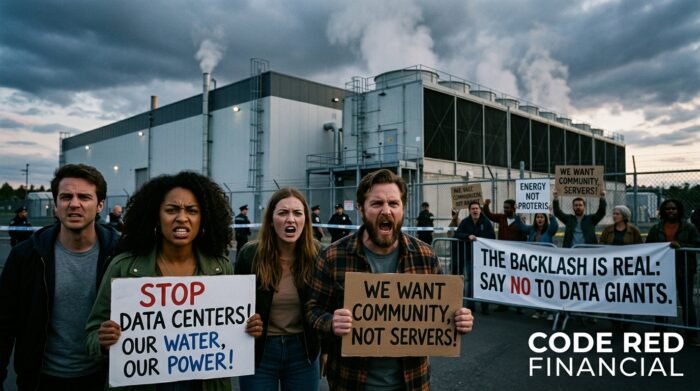
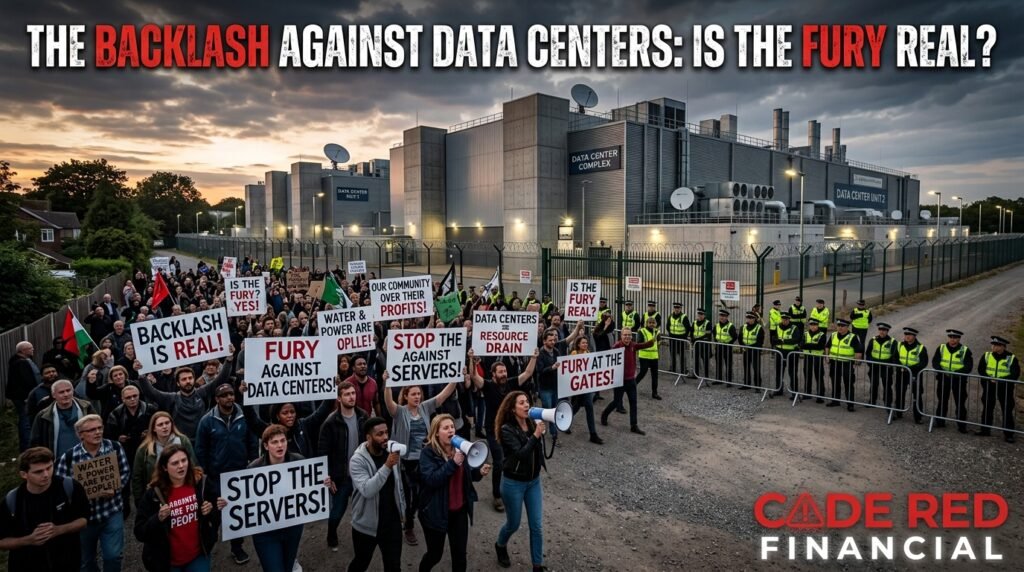
Because the pushback against data centers is real, it’s getting louder, and it’s coming from all directions. And I mean all directions. This isn’t some niche environmental grievance or a local planning dispute that gets buried on page twelve. The opposition to data centers might actually be one of the only things uniting people who agree on virtually nothing else right now. The environmentalist and the fiscal hawk. The rural landowner and the city council member. The political left and the political right. When something brings that crowd together, it’s probably worth paying attention.
So I want to dig into this properly. Is the fear actually justified? Are we watching the smartest infrastructure bet in a generation, or the most expensive collective miscalculation in corporate history? And what does any of it mean for you — as an investor, as a taxpayer, or just as someone trying to understand where all of this is heading?
Nobody Wants One In Their Neighbourhood. And I Get Why.
The tech industry’s standard response to community opposition is fairly predictable. Progress requires infrastructure. Infrastructure requires land. And if you’re against the infrastructure, you’re against the progress. It’s a tidy argument. It’s also a little bit insulting to the people being asked to live next to these things.
Because the objections aren’t irrational. Data centers drink enormous amounts of water for cooling. They pull so much electricity from local grids that, in some cases, utility companies have had to delay shutting down fossil fuel plants they’d already committed to retiring. They’re noisy. They consume significant land. And relative to all of that, they create surprisingly few permanent local jobs.
I saw a comment on a social media a platform recently, and to be quite honest, I could not resist the urge to laugh at what some might consider harsh and what others may very well deem is a just serving to the tech bros. The comment stated that that if tech execs or the current President of the United States are so stoked about data centers, they ought to stick them in the wings of those 15,000-50000 square-foot homes they barely live in. Extreme? Perhaps, but it hits on a real nerve. Which, yes, sounds absurd. But the underlying point isn’t, is it? These facilities aren’t being built in the communities where the executives and shareholders actually live. They’re going where land is cheaper, where local governments are hungrier for revenue, and where communities have less political leverage to say no. That’s not a conspiracy. Imagine retiring to a quiet community in the Blue Ridge, only to have eminent domain carving up your beautiful piece of rural paradise you have spent virtually your entire adult life pillaging towards (Well that’s what it felt like anyway) and feeling powerless to stop it. Sadly, people are being told that’s just how capital moves.
The Balance Sheet Situation Should Make You a Little Nervous
Now here is another nugget of information we should all find even more interesting, particularly for those curious about the financial aspects of this buildout, and it is that something clearly, has happened to the financial profile of several major technology companies over a remarkably short period of time, and I don’t think it’s getting nearly enough attention. Oracle — a company that used to sit on cash reserves that would make most CFOs emotional — has transformed itself into a business carrying billions in debt. And it did that deliberately, chasing data center capacity. Meta, Google, Microsoft — companies that used to treat their balance sheets like fortresses — are burning through capital at a pace that would have seemed unthinkable three years ago.
The bet being made here, across all of them, is enormous. It’s essentially this: generative AI demand will not just hold up, it will expand at a scale that justifies the capital being committed today. That’s the thesis. And it isn’t a small thesis. We’re talking hundreds of billions of dollars, much of it financed through debt, built on demand projections that are, let’s be honest, still projections.
History doesn’t always cooperate with the business plan. We’ve seen infrastructure buildouts of this scale before — the railways in the nineteenth century, fibre optic cables in the 1990s — and the pattern tends to be the same. The infrastructure itself often does turn out to be transformative. But the companies that financed the buildout don’t always survive long enough to enjoy it. Some will come out of this looking visionary. Others will look like they bet the entire organisation on a timeline that didn’t hold. That’s not pessimism — that’s just the nature of risk. And honestly, isn’t that distinction exactly what separates the companies that are merely good from the ones that turn out to be truly great?
The Space Question Nobody Is Taking Seriously Enough
I want to raise something that tends to get treated as a footnote, and I think it deserves considerably more than that.
As resistance to terrestrial data centers has grown, serious thinking has started to emerge around orbital infrastructure — putting processing capacity in space, where you sidestep the land disputes, the water usage complaints, and the community opposition entirely. And on one level, you can see the appeal.
But there’s a concept called the Kessler Syndrome. NASA scientist Donald Kessler described it back in 1978 — the idea that once the density of objects in low Earth orbit crosses a certain threshold, collisions start generating debris, debris causes more collisions, and you end up with a cascade that renders certain orbital bands unusable for potentially generations. We’re not there today. But we are adding satellites and orbital infrastructure at a pace that would have seemed extraordinary even a decade ago, and the honest answer is that no one is entirely certain where the threshold sits.
If space-based data centers become a real part of the AI infrastructure stack — and people are genuinely working on this — we may be trading one set of problems for something with significantly more permanent consequences. That seems like it should be part of the conversation. It mostly isn’t.
Will The Economics Actually Work Out?
So here’s the question I keep coming back to. Will data centers be a net positive for the economy? And I ask that with genuine curiosity, not a predetermined answer.
The optimistic case is real. If AI-driven productivity improvements materialise at anything like the projected scale, the economic benefits could be substantial — deflationary, growth-enhancing, broadly positive. The infrastructure has to be built by someone, and the capital going in now is, in that reading, just the cost of getting there.
But the pessimistic case is also real. A lot of the productivity gain from AI may flow to capital rather than labour. The communities absorbing the noise and the grid strain and the water consumption may see very little of the economic upside. And if the demand projections that are underpinning all of this debt turn out to be too optimistic, some of these companies are going to find themselves in a genuinely difficult position.
My honest read is that the truth lands somewhere between those two poles, as it usually does. Some of this infrastructure will prove essential. Some of it will prove overbuilt. And some of the companies making these bets won’t be around long enough to find out which category they’re in.
So Is The Case Against Data Centers Valid?
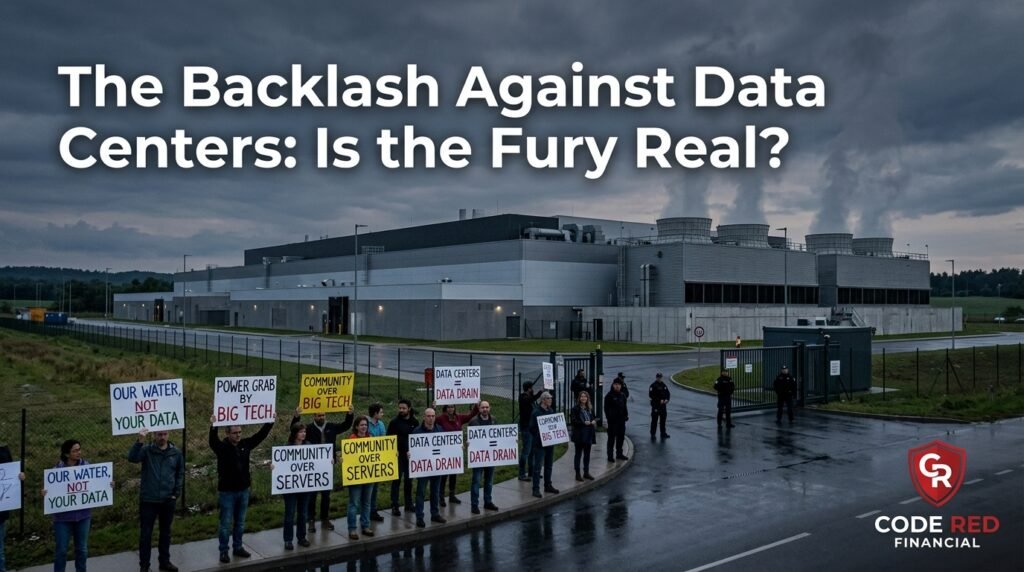
What I find most striking isn’t that the opposition exists. It’s who’s part of it. When something unites people who normally can’t agree on anything, that usually means a real nerve is being touched.
The concerns about energy, water, community impact, orbital congestion, and who actually captures the economic benefit — those aren’t fringe concerns. They’re legitimate. And the communities being asked to absorb the costs of this infrastructure deserve more than a planning approval and a press release.
At the same time, I’m not going to pretend the technology isn’t real or that the companies investing in it are being reckless without reason. These are calculated bets. Some of them will pay off enormously. Some won’t. That’s the nature of this kind of moment in history.
But confidence, however well-placed, isn’t the same thing as certainty. And right now, a lot of very large organisations are behaving as though it is. That gap — between confidence and certainty — is exactly where the interesting risk lives.
And if there’s one thing I’ve learned overtime and watching markets do what markets do, it’s that the interesting risk is almost always the one people are least comfortable discussing, nevertheless, the question still beckons, what will the ultimate outcome be between hyperscalers and the opposition.
Disclaimer: This article is for informational purposes only and does not constitute financial or investment advice. Consult with a qualified financial advisor or tax professional before making any decisions about your investments or retirement accounts.
Jay Sadio, MBA