
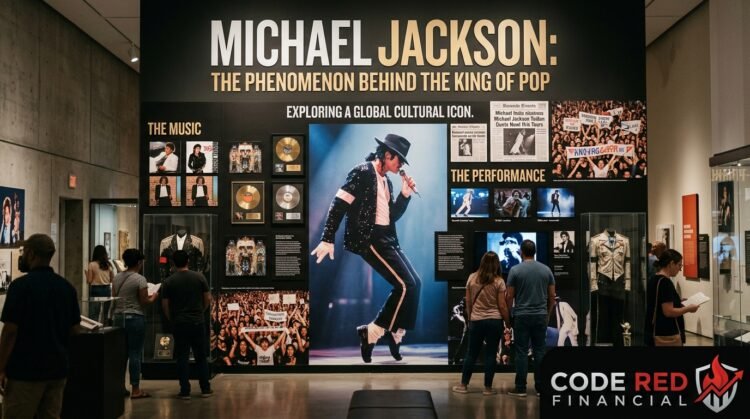
The Billion‑Dollar Blueprint of a One‑Man Global Economy
To the uninitiated, it might seem strange—maybe even absurd—to find an article about Michael Jackson on a business and financial platform. But for anyone who lived through the height of his fame, the connection is obvious. The man wasn’t just a superstar; he was a global economic engine, a cultural export so powerful that entire industries bent around his gravitational pull.
And now, with the recent surge of interest surrounding the new biopic Michael, the world is being reminded—especially younger generations—of just how massive that engine once was.
I am not here to discuss the controversies. This is about commerce, cultural impact, and the sheer financial force of a man who turned music into a multinational enterprise. It’s about understanding the scale of an artist who didn’t just dominate charts—he reshaped them.
Michael Jackson as an Economic Force
To say Michael Jackson was “popular” is like saying the sun is “warm.” It’s technically true, but it misses the magnitude. Jackson wasn’t merely a celebrity—he was an event, a global phenomenon whose influence stretched across continents, cultures, and industries.
His ability to generate wealth was unparalleled:
- Record sales that shattered global benchmarks
- Tours that sold out stadiums in minutes
- Merchandising that turned his image into a billion‑dollar brand
- Music videos that transformed MTV from a niche channel into a cultural powerhouse
Each of these deserves its own chapter, but let’s start with the one that changed everything: the music video.
When Music Videos Became Global Events
Before Michael Jackson, music videos were promotional tools. After Michael Jackson, they were blockbusters.
His videos weren’t just watched—they were premiered, like Hollywood films. They were televised events that drew audiences in the hundreds of millions. According to several reports, the premiere of “Thriller” reached an estimated 500 million viewers worldwide, a number that dwarfs even modern streaming records.
That single video didn’t just boost Jackson’s career—it rescued MTV, expanded the global music video market, and set a new standard for visual storytelling in music. It also created a template for artists who came after him, from Beyoncé to Lady Gaga.
If you want to understand the economic impact of a single creative work, look no further than Thriller. It wasn’t just a video; it was a cultural export that generated billions in downstream revenue.
For anyone curious about how artists today leverage visuals, the evolution from Jackson’s era to platforms like YouTube and TikTok is worth exploring.
When Halftime Became Prime Time
Then came the 1993 Super Bowl halftime show, a performance so iconic that it permanently changed the NFL’s approach to entertainment.
Before Jackson, halftime shows were filler—marching bands, themed medleys, and forgettable performances. After Jackson, the halftime show became the most valuable 12 minutes in advertising, a global showcase for the world’s biggest artists.
The NFL didn’t just book a performer; they booked an economic catalyst. Ratings skyrocketed. Advertising revenue surged. The halftime show became a cultural institution.
Today, artists like Beyoncé, Rihanna, and Shakira owe the scale of their halftime spectacles to the blueprint Jackson created. If you want to understand the business of entertainment, the Super Bowl is a masterclass—and Jackson was the turning point.
For a deeper look at how halftime shows evolved, you might explore Super Bowl entertainment economics.
Would Michael Jackson Have Been Even Bigger Today?
It’s a fascinating hypothetical: What if Michael Jackson had social media?
Would platforms like TikTok, Instagram, and YouTube have amplified his reach—or diluted the mystique that made him larger than life?
On one hand, social media rewards constant visibility. Jackson, however, thrived on scarcity. His appearances were events. His silence created anticipation. His premieres were global gatherings.
On the other hand, imagine:
- The Thriller dance as a TikTok challenge
- The Bad tour behind‑the‑scenes on Instagram
- The Smooth Criminal lean going viral weekly
- A billion‑view YouTube premiere for every new video
It’s difficult to imagine him being more popular, but it’s easy to imagine him being more monetized. Social media would have added layers of revenue that didn’t exist in the 80s and 90s.
What Is Michael Jackson’s Music Really Worth?
Recently, headlines have highlighted massive catalog sales—Justin Bieber’s catalog reportedly sold for around $200 million, while other artists have seen valuations in the billions. It raises an obvious question:
What is Michael Jackson’s catalog truly worth?
The answer: Likely more than any catalog in modern music history.
Why?
- Global longevity: His music remains relevant across generations
- Streaming dominance: Jackson consistently ranks among top legacy artists
- Cultural ubiquity: His songs appear in films, commercials, sports events, and viral trends
- Publishing rights: Jackson famously owned valuable catalogs beyond his own
If catalogs today are selling for billions, Jackson’s would be in a category of its own. For anyone interested in the business behind catalog valuations, exploring music publishing economics is a great next step.
Why Gen Z Is Rediscovering Michael Jackson


As of this writing, the biopic Michael has already surpassed $700 million globally—and that’s before its release in Japan, one of Jackson’s most devoted markets.
What’s remarkable isn’t just the box office success—it’s the audience. Gen Z, a generation not yet born when Jackson was moon walking his way into the living rooms and tribal villages of us decades ago, now discovering a part of that cultural spark
Why?
Because true cultural giants don’t fade. They cycle. They reemerge. They find new audiences who recognize authenticity, innovation, and artistry even decades later.
This resurgence also underscores the enduring economic power of Jackson’s brand. A film about him isn’t nostalgia—it’s a profitable global commodity.
To Those Who Didn’t Live Through It
If you didn’t grow up during Jackson’s peak, comparisons to today’s stars—Chris Brown, Beyoncé, Taylor Swift—might seem reasonable. They’re extraordinary talents in their own right.
But Michael Jackson wasn’t just a megastar. He was a global event.
He was the rare figure whose fame transcended borders, languages, and generations. He didn’t just dominate pop culture—he defined it.
Understanding his financial impact isn’t about fandom. It’s about recognizing how one individual reshaped the economics of entertainment.
The Legacy of a One‑Man Empire
Michael Jackson’s story is more than music. It’s a case study in:
- Brand power
- Global marketing
- Cultural economics
- Entertainment innovation
- Long‑term asset value
Few artists—past or present—have generated the kind of economic ripple effect Jackson did. And with the renewed interest sparked by the biopic, his influence is proving once again that true icons don’t disappear. They compound.
If you’re interested in exploring related topics, you might look into:
- Music catalog valuations
- The business of celebrity branding
- Entertainment industry economics
Disclaimer: This article is for informational purposes only and does not constitute financial or investment advice. Consult with a qualified financial advisor or tax professional before making any decisions about your investments or retirement accounts.
Jay Sadio, MBA