
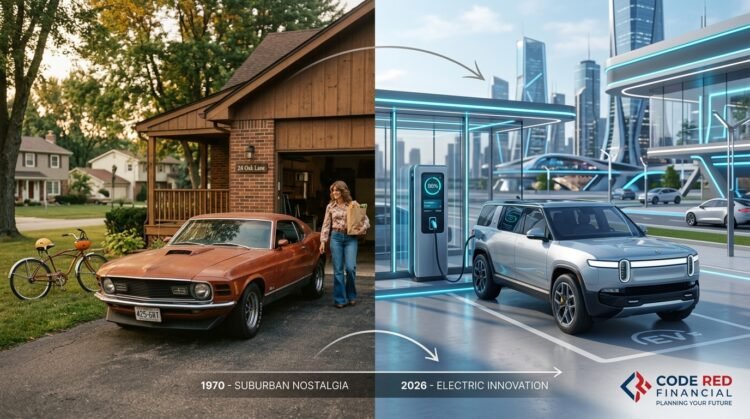
One of the habits I have carried with me since childhood — and I have written about this before — is a certain compulsion toward tracking data. Not casually, but obsessively, with the kind of methodical patience that comes from genuinely wanting to understand how things move through time. So when I began tracking average new vehicle prices just over a year ago, what I found was not merely surprising. It was, in the most precise sense of the word, astonishing. But before we arrive at the present moment and what I believe is a structurally broken relationship between vehicle prices and household income, it is worth pausing to understand how that relationship looked in three earlier decades — the seventies, the eighties, and the nineties — because the contrast, when you sit with it properly, is rather illuminating.
The Seventies: The First Great Disruption
The 1970s were not, by any reasonable measure, a decade of economic tranquillity. The oil shocks of 1973 and 1979 reshuffled the automotive landscape entirely, forcing manufacturers to transition from the powerful, fuel-hungry muscle cars of the previous era toward something leaner and more efficient. The average price of a new car in 1975 sat at roughly $4,800, and for the first time, fuel costs began meaningfully shaping consumer choice at the forecourt. Against a nominal figure like that, it is tempting to dismiss the comparison as irrelevant — of course things cost less in 1975. But the relationship between that sticker price and the income of the household purchasing the vehicle is where the real story begins.
Median household income in 1970 stood at approximately $45,000 in inflation-adjusted terms, rising only modestly to around $46,000 by 1980. In nominal terms for that period, median household income was somewhere in the region of $8,000 to $12,000 across the decade. The implication is significant: a new car in the mid-seventies, at $4,800, represented somewhere between six and eight months of median household income. That ratio — the number of months of average earnings required to purchase an average new vehicle — is the number worth holding in mind as we proceed through the decades.
Family income in the 1970s showed no real gains in inflation-adjusted terms, which tells us that while wages were rising nominally, the purchasing power behind those wages was being quietly eroded. Yet the automotive market of that decade, shaped by genuine cost constraints and foreign competition, kept prices relatively in check. A family of median income could stretch toward a new vehicle without it representing a catastrophic financial commitment. That relationship, as we shall see, would not hold.
The Eighties: Credit, Complexity, and the Beginning of Drift
The 1980s brought a different set of pressures. Car manufacturers were now challenged with meeting new fuel economy targets, and average new car prices rose significantly, settling into the $7,000 to $8,000 range across the decade — roughly a 65% increase on the 1975 figure, which sounds alarming in isolation, but the broader economic picture of the eighties complicates the narrative considerably.
Median household income, after falling during the twin recessions of the early eighties, increased sharply later in the decade, reaching approximately $49,951 by 1990. In nominal terms, this translated to meaningful wage growth for many households, particularly in the second half of the decade. A new car at $8,000 against a household income of perhaps $28,000 to $30,000 nominally still represented a manageable ratio — roughly three to four months of gross earnings, somewhat better than the seventies’ figure once inflation adjustments are applied.
There is, however, a crucial caveat to the eighties narrative that history tends to gloss over. The average income for 80% of American families actually declined in real terms between 1980 and 1989, while the top fifth of Americans saw an increase of nearly 50%, and the income of the top 1% grew by almost 75% over the decade. The headline numbers were doing what headline numbers often do: concealing a distribution problem beneath a tidy average. The families for whom a new car remained genuinely accessible in the eighties were increasingly concentrated toward the higher income brackets. The middle was being hollowed out, quietly and without much ceremony, and the seeds of what we are living through now were planted here.
The Nineties: Prosperity, Expansion, and the $20,000 Threshold
The 1990s represent, in retrospect, the last decade in which something approaching a healthy equilibrium between vehicle prices and broad-based wage growth was even plausible. New car prices climbed from around $12,000 at the decade’s opening toward the $20,000 mark as the millennium turned — a substantial nominal increase, but one that tracked against a period of genuine economic expansion.
The 1990s delivered the longest economic expansion in modern American history, and median household income grew to approximately $54,842 by the year 2000. That meant a new vehicle at $18,000 to $20,000 against a median household income approaching $55,000 — a ratio of roughly four to five months of gross earnings. Tight, but not structurally impossible. The decade also normalised consumer credit for vehicle purchases in a way that compressed the felt cost of the purchase, spreading it across monthly payments that seemed manageable even as the underlying sticker price climbed. That normalisation, it turns out, was quietly preparing consumer psychology for something far more serious to come.
The Post-Pandemic Break
Which brings us, with the patience the data demands, to the period I began tracking — and to the finding that genuinely startled me.
Between January 2000 and January 2021, the Consumer Price Index for new vehicles increased by just 4.2% across the entire two-decade period. Read that slowly, because it is rather remarkable. Twenty years of inflation, of commodity cost pressures, of rising labour complexity, and the new vehicle CPI barely moved four points. Then came the pandemic, the supply chain fractures, and the semiconductor shortage — and the dynamic shifted entirely.
Between January 2021 and June 2024, the CPI for new vehicles rose 19.2%, with the average selling price reaching $47,000 in 2023 — a 32% gain from 2018. By 2024, the average transaction price had reached $48,759 according to Cox Automotive, and by 2025 the average was being reported at $50,080. To put that in the terms we have been tracking throughout this article: a new vehicle now represents, for the median American household earning roughly $80,000, somewhere in the region of seven to eight months of gross income — a ratio worse than any decade we have examined, and that is before accounting for the financing costs that accompany it, with auto loan rates running at nearly 8% as of mid-2024, more than double the rate from 2021.
And yet, what is perhaps most revealing about this period is not simply the price trajectory — it is the market’s response to it. Because the market has, quietly and with considerable force, pushed back.
The Inventory Reckoning: What the Dealer Lots Are Telling Us
A few weeks ago, I did what I often do when the data invites a closer examination. I spent the better part of a day working through Autotrader and CarGurus, methodically searching through the new car listings of every major manufacturer — at least three to four models each, including sub-models — with one specific question in mind: how many prior-year 2025 models were still sitting unsold on dealer lots, and what incentives were being deployed to move them? What I found was, to put it plainly, a rather significant vindication of the thesis that vehicle pricing had drifted well beyond what the median buyer could reasonably absorb.
Jeep offered some of the most dramatic examples, though they were far from alone. Incentives approaching a third of the vehicle’s MSRP were not difficult to find across multiple brands — a figure that, when you sit with it, is not the mark of a healthy market finding its equilibrium. It is the mark of a pricing strategy that misjudged the consumer entirely. Stellantis — the parent company of Chrysler, Dodge, Jeep, and Ram — saw its U.S. sales decline by 21% year-over-year as inventory piled up on lots, with critics pointing to the company’s decision to push premium sticker prices despite the brand’s lingering reputation for below-average reliability. Jeep vehicles were averaging 126 days on the lot by October 2024, compared to an industry average of 81 days — a disparity that speaks not to seasonal fluctuation but to a more fundamental misalignment between what was being asked and what buyers were willing to pay. Price reductions ranging from $1,000 to $4,000 were deployed across the Grand Cherokee Laredo lineup to bring it below $40,000 including destination fees, while the Gladiator saw reductions of over $8,000 on certain trims compared to the prior year’s models.
At the NADA Show, Stellantis executives openly apologised for the disorder of 2024, during which their U.S. sales dropped 15%, and received standing ovations from dealers simply for acknowledging what had gone wrong. There is something instructive in that image — a room full of franchise dealers applauding a corporate admission of overreach. It captures, rather neatly, the texture of the problem. By April 2025, Stellantis had launched an employee-pricing-for-all promotion across most 2024 and 2025 Chrysler, Dodge, Jeep, and Ram vehicles in a direct effort to address mounting inventory and stagnant demand.
Stellantis is the most visible case, but the phenomenon is not theirs alone. The incentive spending across the industry through 2024 and into 2025 reflects a broader reckoning with the same underlying problem: that the price levels established during the pandemic’s seller’s market assumed a consumer appetite that, once normalised credit conditions returned and real wages remained under pressure, simply was not there.
The Crushing Weight of Everything Else
It would be tempting, having examined vehicle prices in isolation, to conclude that the automotive affordability problem is essentially a contained one — a discrete market correction working its way through a single industry. But that would be to look at the data through far too narrow a lens, and the picture it produces would be dangerously incomplete. Because the car payment does not exist in a vacuum. It sits alongside a mortgage or a rent payment, a grocery bill, a utility bill, an insurance premium — and in every one of those categories, the post-pandemic period has delivered structural increases that wages have not come close to absorbing.
Consider housing first, because it is where the weight lands most heavily. In 1985, the median American home cost $82,800, against a median household income of $23,620 — a price-to-income ratio of roughly 3.5 times earnings, which represented the traditional rule of thumb for what a household could prudently afford. By 2025, the median home had reached $416,900 against a median household income of $83,150 — a ratio of five times earnings. And that national figure, broad as it is, obscures the severity of individual markets. The median home in Los Angeles now costs 12.5 times the median annual household income, with San Jose at 10.5 times and New York approaching 9.8 times. As of the first quarter of 2025, homeownership was considered unaffordable in 17 states — a dramatic deterioration from 2020, when California was the only state in which homeownership met that threshold.
For renters, the picture is no more forgiving. The ratio of median rents to median income has risen from 25% to 30% over the past two decades, which may sound modest in percentage terms but represents, in practical terms, a meaningful compression of the discretionary income that households have available for everything else — including vehicle purchases. For households earning $75,000 annually — a bracket that includes nurses, teachers, and skilled tradespeople — the share of housing listings they can afford has contracted from 49% in 2019 to just 21% today. Even households earning $100,000, a figure well above the median, have seen their affordable options shrink from 65% of listings in 2019 to 37% in 2025.
Then there is the grocery bill, which arrives weekly and therefore carries a particular psychological weight. The price of food at home climbed 29.4% between March 2020 and December 2025 — what began as a pandemic supply chain disruption quickly became the fastest period of food price increases since the 1970s, pushing the average monthly household grocery budget to nearly $700. From 2021 to 2022 alone, food prices rose approximately 11% — the largest annual increase in food costs since the 1980s. The pace has since moderated, but the cumulative effect has not reversed. Prices that ratchet upward during an inflationary period do not tend to ratchet back down once the inflation recedes; they simply stop climbing quite as quickly. The household that was paying $500 a month for groceries in early 2020 is not returning to that figure.
When you combine all of this — the $50,000 average vehicle price financed at nearly 8%, sitting atop a housing cost that has consumed an ever-larger share of household income, layered over a grocery bill that is roughly a third higher than it was five years ago — what emerges is not merely an automotive affordability problem. It is a comprehensive structural squeeze on the median American household, one in which every major budget line has moved simultaneously and in the same direction, while wages have followed at a considerable distance. The vehicle purchase, once an aspiration that required planning and discipline but remained within reach for a family of median income, has now become a decision that forces genuine trade-offs against the other costs of simply living.
This is what makes the lot full of aging 2025 Jeeps, or the incentives approaching a third of MSRP, something more than a corporate misstep or a market inefficiency. It is a signal — visible, data-driven, and rather difficult to argue with — that the gap between what manufacturers chose to charge and what the median household can actually bear has become wide enough to be felt at scale.
What the Numbers Are Really Telling Us
The arc from the seventies to the present day is not simply a story of rising prices. Rising prices are a constant of any economy. The story, told properly, is about the divergence between what vehicles cost and what wages can support — a gap that widened gradually through the eighties and nineties and then, after 2021, widened sharply and suddenly in a way that has yet to fully correct. And it is a story that cannot be read clearly unless it is set against the full context of what else has happened to household budgets in the same period.
The family buying a new car in 1975 was stretching perhaps half a year’s income toward that purchase, and the rest of their budget — housing, food, utilities — was absorbing a manageable share of what remained. The family doing the same today is stretching nearly a full year’s gross earnings toward the vehicle alone, financing it at twice the interest rate of four years ago, returning home to a mortgage or rent payment that has never been more punishing relative to income, and stopping at a grocery store on the way where the cumulative price increases of the past five years remain stubbornly embedded in every aisle. The physics of that equation — and I use the word deliberately, because systems under that kind of compound pressure do not simply absorb it indefinitely — is not sustainable. The data is already pointing toward the answer. We need only have the patience, and the honesty, to read it carefully.
Disclaimer: This article is for informational purposes only and does not constitute financial or investment advice. Consult with a qualified financial advisor or tax professional before making any decisions about your investments or retirement accounts.
Jay Sadio, MBA