
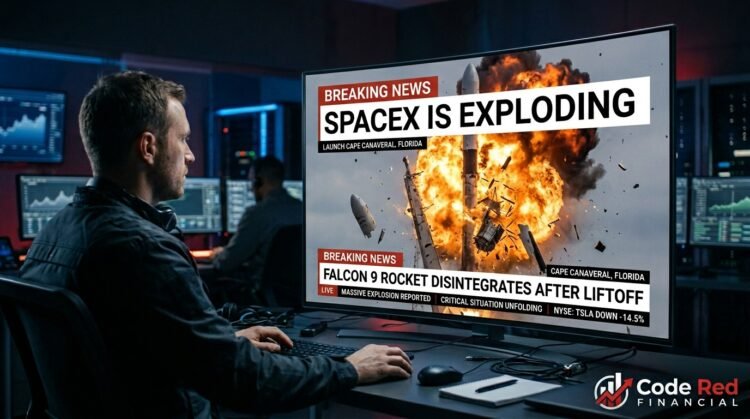
Is SpaceX Really A 50 trillion Dollar Company?
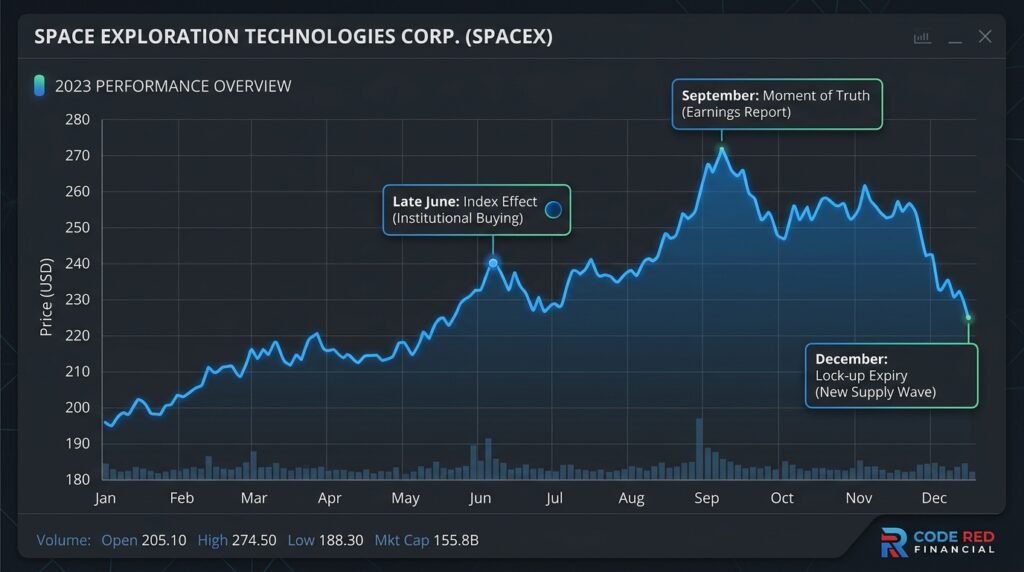
So, full confession, I’ve traded in and out of SpaceX a couple of times since it went public and while I have no intention of acquiring the stock as a long-term component in my portfolio, it has nevertheless garnered significant attention due to its ambitious objectives and advanced technology in the aerospace sector.
As a publicly traded company, its financial health is now under constant scrutiny, revealing insights into its revenue strategies and overall market performance. Following its Initial Public Offering (IPO), SpaceX has displayed a robust financial profile characterized by a diverse array of revenue streams.
But the idea of the perfectly linear, “to-the-moon” growth narrative championed by the company and its key backers faces an increasingly crowded and aggressive field of competitors determined to break its near-monopoly.
1. The Government Foundation (And the Rivals Eyeing It)
A crucial element of SpaceX’s income derives from government contracts, primarily with NASA and the U.S. Department of Defense. These agreements not only solidify long-term financial support but also underline SpaceX’s status as a leading player in the national defense and space exploration sectors. Launch contracts with these agencies contribute significantly to the company’s revenue, providing a stable foundation for its financial health. Furthermore, as SpaceX continues to secure more contracts, it bolsters its credibility and assurance for investors.
The Reality Check: Even this historically secure foundation is attracting rival forces. Legacy players and well-funded aerospace entities are aggressively bidding for national security payloads and exploratory missions. As these rivals scale their own reusable launch capabilities, the assumption that SpaceX will permanently capture the lion’s share of high-margin institutional contracts becomes vulnerable. Government agencies hate single-source dependency—they want to diversify their spending.
2. Starlink vs. Amazon Leo: The Pricing War Ahead
In addition to government contracts, SpaceX’s Starlink project is instrumental in augmenting its financial robustness. Starlink, dedicated to providing global broadband service via a satellite constellation, opens up a new revenue frontier. With millions of subscribers potential worldwide, this initiative aims to enhance connectivity in remote areas while generating substantial recurring income. The rollout of Starlink service has shown promising results, depicting a growing customer base that further stabilizes SpaceX’s financial standing.
Looking at Starlink through a purely linear growth lens, however, ignores a massive incoming wave of macroeconomic friction. The most formidable threat looms from Amazon Leo.
Why Amazon Leo is a threat: Backed by Amazon’s practically bottomless capital reserves and its massive, pre-existing consumer and enterprise ecosystem, Amazon Leo is rapidly positioning to enter the space. Amazon’s ability to bundle satellite broadband with its pervasive AWS cloud architecture and Prime consumer services presents a structural threat that SpaceX cannot easily replicate.
We must also consider sovereign-backed mega-constellations from China and the European Union’s IRIS² initiative that are entering the fray, driven by geopolitical imperatives rather than pure profit motives. This influx of capital and orbital infrastructure alters the market dynamic entirely. Rather than a wide-open frontier for Starlink to conquer unilaterally, the low Earth orbit sector is transitioning into a battleground of intense capital expenditure.
The Global Threat Matrix: China Cracks Reusable Flight If you think SpaceX holds an unshakeable launch monopoly, today’s breaking news is a massive wake-up call for the markets: China just pulled off its first successful orbital-class booster recovery. On July 10, 2026, the state-developed Long March 10B—a direct medium-lift competitor to SpaceX’s workhorse Falcon 9—delivered a satellite to orbit and successfully returned its booster to an offshore platform just six minutes later. Crucially for investors, China skipped heavy landing legs entirely, choosing instead a novel “landing hook” and net-capture system that slashes vehicle mass to maximize payload capacity. This tech breakthrough, which sent Chinese aerospace stocks soaring to their daily limits, will radically lower launch costs for Beijing’s own massive, state-subsidized satellite constellations. With plans to re-fly this exact booster by the end of the year, a wave of cheap, sovereign-backed reusable launch options is about to hit the international market—directly threatening the pricing power and linear margin expansion that SpaceX investors have taken for granted.
Overall, SpaceX’s financial outlook appears positive due to its combination of substantial government contracts and innovative projects like Starlink. These revenue sources not only fortify the company’s current financial stability but also lend significant potential for long-term growth, thereby affirming SpaceX’s position in the aerospace industry. But Starlink will have competition from Amazon’s LEO and other entrants to the market in the very near future and in my estimation, the crowded field will result in price compression.
This impending market saturation shatters the assumption of an uninterrupted, frictionless path to market dominance and will inevitably erode average revenue per user (ARPU), disrupting the highly optimistic cash-flow timelines projected by early backers.
3. Data Centers in Orbit: An Ambitious Proposal
SpaceX has proposed a revolutionary concept of deploying data centers in orbit, potentially altering the landscape of cloud computing and data processing. This innovation aims to harness the unique advantages of a space environment, where low latency and proximity to satellite communication can facilitate faster data transmission and processing. The envisioned data centers could efficiently manage vast amounts of information generated by modern applications, benefiting various sectors including telecommunications, aerospace, and research.
One significant advantage of orbital data centers is their ability to leverage solar power continuously. In space, solar panels can operate at full capacity without interruption from atmospheric conditions, potentially providing a sustainable energy source for the operational needs of these centers. Moreover, the strategic placement of these facilities could minimize latency for end-users and businesses relying on satellite technology, creating opportunities for real-time data processing and analysis.
The Tech Giant Advantage: This frontier will not belong to SpaceX alone. The competitive moat for orbital computing relies heavily on integration with ground-based cloud infrastructure. Tech giants like Amazon already possess the global corporate client bases, edge-computing nodes, and software ecosystems required to make space-based data processing practical. If Amazon successfully pairs its Amazon Leo constellation with AWS-linked orbital data storage, it could bypass the need for SpaceX’s architecture entirely. For SpaceX investors, this means the projected growth from “space cloud” margins could be severely diluted by entrenched hyperscalers moving upward into orbit.
I am not certain if many of the Elon Musk disciples fully comprehend the technical challenges associated with implementing data centers in space and that should not be overlooked. The harsh environment of space presents obstacles such as extreme temperatures, radiation exposure, and microgravity effects, which can all adversely affect equipment performance and longevity. Ensuring the reliability of hardware and software in such conditions would require significant advancements in technology and engineering. Additionally, the logistical complexities of launching, constructing, and maintaining these data centers must be addressed, significantly influencing the overall viability of this concept.
And let’s talk about the financial implications of deploying orbital data centers and this must be thoroughly analyzed. The initial investment required for research, development, and deployment is substantial, raising questions about the return on investment and long-term sustainability of such an enterprise. Exploring partnerships, government backing, or commercial applications will be essential for making orbital data centers a financially sound venture. This becomes an even steeper uphill battle when competitors like Amazon can cross-subsidize their space data R&D using massive, reliable profits from their terrestrial businesses, squeezing SpaceX’s margins before the concept can fully mature. One would argue that deploying data centers in the ocean like China’s fully operational AI-focused cluster, might very well be a better option, but then there is the eco-system debate, so it remains to be seen.
4. The Brutal Economics of Orbital Maintenance
Maintaining spacecraft data centers in orbit is pivotal to ensuring continuous operations and reliable data management. Given the rapid advancement in technology, the frequency of necessary updates and maintenance can be quite challenging. Regular updates to the software and systems are mandated to keep up with emerging technologies and security threats, which necessitates a robust maintenance schedule to avoid disruptions in service.
The hardware longevity in these data centers also poses a significant consideration. In the environment of low Earth orbit, components face extreme conditions such as radiation exposure and temperature fluctuations. These factors can potentially deteriorate hardware at an accelerated rate compared to ground-based systems. Thus, choosing components designed for extended operational life is essential, guided by the understanding that despite the best choices, hardware will require replacement or significant upgrades to remain viable.
This constant lifecycle of decay and replacement introduces an ongoing operational expense (OpEx) that threatens the high-margin narrative sold to Wall Street. In a highly competitive environment where Amazon Leo or sovereign constellations are undercutting prices, the financial burden of continuously launching replacement hardware to mitigate orbital degradation becomes a critical vulnerability. Growth models that assume declining launch costs will protect margins fail to account for a scenario where rival networks trigger a pricing race to the bottom, leaving less capital available to fund these relentless maintenance cycles.
Listen, the challenges presented by obsolescence cannot be ignored. In the rapidly evolving fields of artificial intelligence (AI) and computing, the risk of hardware and software becoming outdated is ever-present. Operators must strike a balance between adopting cutting-edge technologies and maintaining compatibility with existing systems. Keeping a flexible architecture allows for incremental upgrades without necessitating a complete overhaul of the data center’s infrastructure.
The maintenance and lifespan considerations for orbital data centers are multifaceted. Continuous updates and careful hardware selection are crucial. Moreover, addressing obsolescence proactively through strategic planning and investment in adaptable technologies will ensure these data centers remain functional and effective in the fast-paced landscape of space exploration and data management.
5. Political Risks and the Lobbying War
SpaceX, a leader in aerospace manufacturing and space transport services, operates within a unique environment heavily influenced by political dynamics. The company’s reliance on government contracts, particularly with NASA and the U.S. Department of Defense, exposes it to potential risks stemming from shifts in political leadership or policy. These risks can have profound implications for SpaceX’s business model and future projects.
Political risks manifest in various forms, ranging from changes in administration priorities to alterations in funding allocations for space exploration initiatives. Different political parties usually have divergent views on space spending. In times of Democratic leadership, there might be increased emphasis on collaboration with international partners and broader investment in educational programs and scientific research. Conversely, a Republican administration might pursue a more aggressive stance focused on national security and defense contracts. This dichotomy can impact SpaceX’s ability to secure contracts that are critical to its operations and growth trajectory.
Compounding this domestic risk is the global political leverage wielded by international competitors. For instance, Amazon’s deep, institutional relationships with global enterprises and sovereign nations give it a distinct diplomatic edge when negotiating international landing rights for Amazon Leo. Countries hesitant to rely on a single, dominant American corporation like SpaceX for their core digital infrastructure may actively favor alternative networks like Amazon Leo or Europe’s IRIS² to maintain strategic optionality.
It is also important to consider the evolving geopolitical landscape can inject uncertainty into international contracts and partnerships. Regulatory changes, import tariffs, and shifting alliances can all affect SpaceX’s operational framework. For example, a hardline approach towards specific nations could jeopardize international collaborative projects and partnerships that SpaceX might pursue to enhance its technological capabilities and market reach.
And then there is the significance role lobbying efforts play a in shaping policies that directly impact SpaceX. As government budgets often depend on legislative approval, changes in Congress can either bolster or undermine funding for space projects, presenting additional challenges for SpaceX.
With Amazon and other deep-pocketed telecom coalitions ramping up their own space-policy lobbying, the regulatory landscape is bound to become much more restrictive for first-movers. Changes in anti-trust scrutiny, orbital debris regulations, and spectrum allocation could be weaponized by late-arriving competitors to slow down SpaceX’s expansion. Thus, the interplay of political and competitive factors necessitates that SpaceX remain adaptable and prepared for potential fluctuations in its operational environment, ensuring sustained support for its ambitious projects against sudden, non-linear disruptions.
Disclaimer: This article is for informational purposes only and does not constitute financial or investment advice. Consult with a qualified financial advisor or tax professional before making any decisions about your investments or retirement accounts.
Updated 07/10/2026
Jay Sadio, MBA