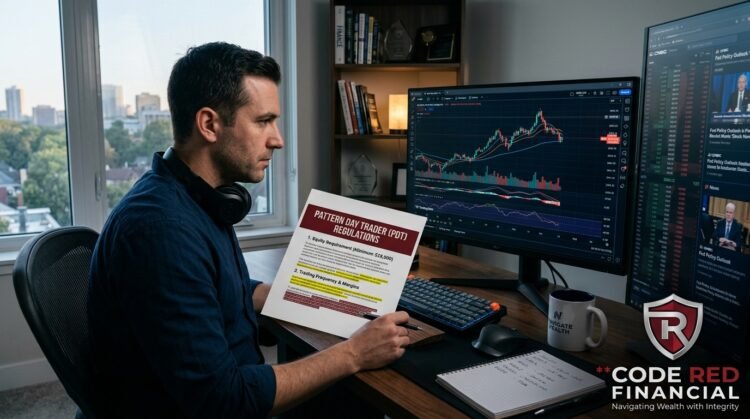
The “Pattern Day Trader” (PDT) rule—the $25,000 threshold that has haunted retail traders for decades—is officially dead. As of June 4, 2026, the regulatory landscape for day trading in the United States has undergone its most significant shift in a generation.
If you are a trader who has been grinding away at a small account, feeling the frustration of being “locked out” by a government-mandated trade counter, this is the news you’ve been waiting for. But if you think this is simply a “green light” to gamble, you’re missing the point. The regulations haven’t vanished; they have evolved into something more sophisticated, more real-time, and in many ways, more dangerous for the unprepared.
The Death of the PDT Rule: A New Regulatory Era
For over twenty years, the PDT rule was the gatekeeper. It was a crude, binary measurement: did you execute more than four day trades in a rolling five-business-day window? If yes, and you had less than $25,000 in your account, you were effectively benched. It didn’t matter if your strategy was sound, if your risk management was impeccable, or if you were a disciplined trader. The rule was a blunt instrument that treated all accounts under $25,000 as “high risk” and restricted their ability to interact with the market.
That is now over. On April 14, 2026, the SEC approved FINRA’s proposal to eliminate the PDT designation and the $25,000 minimum equity requirement entirely. Effective June 4, 2026, these archaic barriers were replaced by a new framework: Intraday Margin Standards.
This change acknowledges that the market of 2026 is vastly different from the market of 2001. With near-zero commissions, fractional share trading, and the massive rise of 0DTE (zero-days-to-expiration) options, the old “four-trade” limit felt like trying to use a rotary phone to send a text message. It was time for a change.
The Reality Shift: From “Counting” to “Risking”
So, what is replacing the old rules? If you aren’t being measured by a trade counter, how are you being measured?
The new framework moves away from the frequency of your trades and toward the risk of your positions. Your broker-dealer is now required to monitor your account’s intraday margin usage in real-time.
In the past, you were worried about getting a “PDT flag.” Now, your concern is the Intraday Margin Deficit.
Think of it this way: Your broker is no longer looking at your “trade count” as a proxy for risk. They are looking at your actual account equity relative to the exposure you have in the market at any given second. If you enter a trade that pushes your market exposure beyond what your account equity can safely support—based on the firm’s margin requirements—you have triggered an intraday margin deficit.
Different brokers will implement this differently. Some will offer a “buffer” or a real-time monitor that warns you or blocks the trade before it happens. Others may perform end-of-day calculations. But the fundamental truth remains: You are now accountable for your actual leverage, not just your trade history.
Why the “Freedom” is a Double-Edged Sword
It is tempting to look at this change and see “freedom.” You can trade as often as you like! You can scalp that volatile stock ten times in an hour! You can chase every breakout!
But let’s be completely honest with ourselves, was the PDT rule actually the reason you weren’t profitable?
For most traders, the answer is a resounding “no.” The PDT rule was frustrating, yes. It forced you to sit on your hands when you wanted to trade. But that frustration also acted as a form of forced discipline. It made you wait for the A+ setups. It kept you from “over-trading” or “revenge trading” because you had to ration your limited trades.
Now, that guardrail is gone but the risk of loss still lingers.
If you weren’t profitable when you were limited to four trades a week, the new rules will not make you profitable. They will only allow you to make mistakes faster. You now have the “freedom” to hemorrhage your account in a single morning if you lack a solid trading plan, strict stop-losses, and a disciplined risk-management strategy.
The “Must-Dos” for the Post-PDT World
If you want to survive and thrive in this new environment, you need to evolve your mindset. Stop thinking like a “restricted trader” and start thinking like a “risk manager.”
1. Treat Your Buying Power as a “Ceiling,” Not a “Floor”
Your broker’s platform now likely shows you a “Real-Time Buying Power” widget. Many traders view this as the amount of money they can use. Change that immediately. View it as a danger zone. If you are regularly hitting your maximum buying power, you are significantly over-leveraged. If the market dips against you, you will have no cushion, and you will be liquidated instantly.
2. The Religion of the Stop-Loss
When you were limited by the PDT rule, you might have held through some drawdown because you were “stuck” in a trade. That mentality is fatal in the new world. If a trade goes against you, you must have a hard, pre-determined exit point. With the new rules, you are responsible for your own risk, and the market does not care about your “average down” strategy.
3. Audit Your Position Sizing
If you have a $5,000 account, you shouldn’t be trading like you have $50,000 just because the regulatory “wall” is gone. Keep your risk-per-trade at 1% or 2% of your total account value. If you don’t know how to calculate position size, learn it today. It is the single most important skill for long-term survival.
4. Understand Your Broker’s “House” Rules
Just because FINRA removed the PDT rule doesn’t mean your broker isn’t going to have their own internal risk controls. Many brokerages are still very conservative. Check your account settings and contact your broker to understand how they calculate intraday margin. Don’t rely on what you heard in a forum; rely on your specific platform’s requirements.
The Psychological Trap: Avoiding “Chop-Happiness”
The biggest danger you face now is “chop.” You will be tempted to trade every minor fluctuation in the market. You will see a green candle and want to jump in. You will see a red candle and want to jump out.
This is “chop-happiness,” and it is the fastest way to lose money in the market.
Remember: In the short term, the market is a zero-sum game. The institutional traders and the algorithms you are trading against want you to over-trade. They want you to pay the spread, pay the fees, and get caught on the wrong side of a reversal. By removing the PDT rule, the regulators have made the market more “efficient,” which—for the retail trader—can often mean it has become more predatory.
The Goal is Longevity
The death of the PDT rule is a milestone for retail investor access. It is a win for those of us who have long argued that a $25,000 balance is not a meaningful metric for whether someone should be allowed to trade and if I must confess, I have sent numerous emails to the SEC over the years, particularly in previous years when my paltry trading account limited my flexibility.
But do not confuse “market access” with “trading success.”
Keep in mind that the market is not a vending machine where you put in discipline and get out profit. It is a complex, volatile, and often unforgiving environment. Use this newfound freedom to trade with intention, not impulse. Wait for the high-probability setups. Protect your capital with religious fervor. And most importantly, remember that the goal is not to be the most active trader in the room—it is to be the trader who is still standing when the bell rings at 4:00 PM.
The rules have changed, but the fundamental reality of the market remains: It’s not how many trades you make that builds wealth—it’s the quality of the ones you keep.
What about you? Are you planning to lean into the new freedom and increase your trading frequency, or are you going to keep playing it slow and steady? Let me know in the comments—I’m curious to see how everyone is adjusting to the new reality.
Disclaimer: This article is for informational purposes only and does not constitute financial or investment advice. Consult with a qualified financial advisor or tax professional before making any decisions about your investments or retirement accounts.
Jay Sadio, MBA