
Moneyfluencers are reshaping financial literacy, is it smart advice or just risky viral noise?
I can’t recall precisely which channel I was watching recently—whether it was CNBC or Bloomberg TV—but the topic revolved around the anxiety of young college graduates, particularly from more elite schools, and their inability to secure what was once an almost guaranteed job offer even before graduation. This got me thinking about the dramatic shift in the financial ecosystem, which has created uniquely difficult challenges for today’s young professionals.
The stability once taken for granted—traditional pensions, dependable fixed‑income returns, and affordable housing—has largely vanished. This is not to suggest that opportunities for success have disappeared altogether. Yet an entire generation now faces the burden of overwhelming student debt, persistent inflation, and economic volatility, while bearing primary responsibility for funding their own long‑term security—unlike many boomers who benefited from guaranteed pensions.
This environment creates not just anxiety, but a desperate search for accessible, actionable answers. When you feel like the system is rigged against you, you don’t want a lecture; you want a lifeline.
This is the void that the Moneyfluencer (or “Finfluencer”) industry has filled.
On high-velocity platforms like TikTok and Instagram, these creators translate complex topics—Roth IRAs, the nuances of the FIRE movement, and passive income strategies—into engaging, digestible clips measured in seconds. They are relatable, they possess high energy, and they speak the language of digital culture. By comparison, the traditional financial services industry often feels cumbersome, expensive, and antiquated.
The critical question, however, is this: While FinTok has successfully democratized exposure to financial concepts, is the advice robust enough to carry a generation through decades of high-stakes investing?
Is this a powerful force for literacy, or a high-risk engine where an entire generation’s financial security is built on tips from uncredentialed—and potentially compromised—digital personalities?
To answer that, we have to look at why this content is so seductive, the hidden risks lurking in your feed, and where to draw the line between “education” and “advice.”
The Seduction: Why Digital Advice Overcomes Traditional Friction
The rise of the Finfluencer is a direct market reaction to the structural failures and high friction points of the traditional financial advisory industry. Simply put: The old guard made it too hard for young people to get in the door.
1. Eliminating Barriers to Entry
For young investors, seeking counsel from a traditional Certified Financial Planner™ (CFP®) is often intimidating, expensive, and exclusionary. Advisors typically focus on High-Net-Worth Individuals (HNWIs)—people who already have money—leaving younger adults with minimal assets feeling underserved and ignored.
Moneyfluencers provide an appealing alternative that addresses these barriers directly:
- Instant Accessibility: The content is free, immediate, and available 24/7. There is no appointment necessary, no suit and tie required, and most importantly, no minimum asset requirement to start learning.
- The Relatability Factor: Creators often share personal narratives of overcoming debt or starting small. This cultivates a sense of trust and genuine shared experience that traditional institutional figures, often viewing the world from high-rise offices, cannot match.
- A Focus on Education: The initial value proposition is pure instruction. Finfluencers excel at demystifying complex financial jargon and explaining foundational concepts—like compounding interest and index funds—using highly effective, modern analogies that actually stick.
2. The Power of Brevity and Algorithmic Discovery
The core genius of FinTok lies in its ability to synthesize complex material into an addictive, easily consumable format.
- Oversimplification for Engagement: A licensed advisor takes the time to discuss “sequence of returns risk” and market volatility. A Finfluencer simplifies the FIRE Movement (“Financial Independence, Retire Early”) into the 4% Rule—“Multiply your annual spending by 25 and you’re done!” While this summary is dangerously incomplete, it is incredibly effective as a cognitive hook. It ignites interest and action where dry facts fail.
- Democratized Exposure: The algorithm’s focus on engagement ensures that financial content finds users who might never have actively searched for it. This process successfully democratizes exposure to financial concepts, accelerating the initial learning curve for millions.
The data clearly indicates this shift: Studies show that over 60% of Millennials and nearly 80% of Gen Z seek financial guidance via social media, confirming that the digital feed has become the primary source of initial financial education.
The Time Bomb: The Inherent Risks of Unqualified Counsel
While the accessibility is a significant benefit, the risk profile of content where virality is prioritized over veracity is critically high. When we move from learning concepts to implementing them based on a 60-second video, we enter dangerous territory.
1. The Fiduciary Flaw: Accountability and Liability
This is the most critical distinction in the financial world. A licensed Certified Financial Planner™ (CFP®) operates under a fiduciary duty, legally compelling them to act solely in the client’s best interest.
In contrast, Moneyfluencers bear no such legal obligation.
- The Credential Gap: A substantial majority of financial content creators lack the formal education, licenses, or regulatory oversight required to offer personalized investment advice. The advice provided is often based on limited personal experience (“This worked for me!”) rather than rigorous, tested methodology.
- Lack of Recourse: If a user follows a Finfluencer’s risky stock tip or aggressive option strategy and suffers significant losses, they have virtually no legal recourse. The creator is insulated, operating in an unregulated space. This lack of accountability creates a high-stakes environment for the follower, demonstrated by surveys where a significant minority of adults admit to taking bad financial advice from social media and losing money.
2. Conflicts of Interest: The Monetization Trap
The financial incentive structure underpinning the Finfluencer economy fundamentally compromises their objectivity. Unlike a fee-only advisor who is paid by you, influencers primarily monetize their large audiences in two ways:
- Selling Proprietary Products: The free educational content frequently serves as a lead-in to selling expensive, non-refundable online courses, exclusive mentorships, or high-cost Excel templates. This practice preys on the user’s fear of missing out (FOMO) on “secret” wealth strategies.
- Sponsored Content and Affiliate Links: Influencers are often compensated by financial service providers to promote specific, sometimes high-fee or high-risk products—from specific whole life insurance policies to low-quality crypto tokens. While regulators like the SEC and FINRA require disclosure, many Finfluencers fail to make these affiliations clear and prominent.
The takeaway: When an investment recommendation is sponsored, the advice is not inherently better or smarter than professional guidance; it is simply louder because it is financially subsidized.
3. The Personalization Paradox
Sound financial strategy is inherently customized. It must be built around an individual’s unique tax bracket, existing debt load, family structure, and specific risk tolerance.
A Finfluencer’s content, delivered to millions, is generic by definition. This lack of personalization renders it inadequate for major financial decisions.
- Example: Advice on “Tax Loss Harvesting” that works brilliantly for a debt-free twenty-something in a low-tax state could be disastrous for a high-income earner facing complex state and federal tax liabilities or wash-sale rule violations.
- Example: Pushing early retirement without explaining healthcare costs.
This systematic oversimplification of topics poses a substantial threat to long-term financial stability.
Navigating the Regulatory Landscape
Regulatory bodies are struggling to manage the sheer volume and velocity of FinTok content. Unlike traditional financial marketing, which is subject to rigorous pre-approval and archiving requirements by FINRA, a viral video can reach millions globally before it even registers on a regulator’s radar.
While the SEC has stepped up enforcement against licensed firms and celebrities promoting unregistered or undisclosed products (like the crypto crackdowns), these regulations primarily govern licensed entities. The regulatory gap surrounding the average, uncredentialed content creator remains vast.
This places the burden of due diligence almost entirely on you, the consumer. The responsible strategy, therefore, involves accepting FinTok as a powerful initial learning resource, while treating any advice given as provisional, pending validation by a licensed professional.
The Smart Path: Leveraging FinTok Wisely
The Finfluencer phenomenon is a permanent fixture in the financial ecosystem. The effective path forward is not to reject it, but to develop robust critical filtering skills.
Three Rules for High-Stakes Financial Decisions:
- Analyze the Motive: Scrutinize the call-to-action. If the creator is steering you toward a specific product, course, or affiliate link in their bio, recognize that their primary motive is likely monetization, not your objective financial health.
- Verify All Credentials: If a creator claims professional status (CFP®, RIA, CPA, etc.), take the essential step of verifying their license and disciplinary history on public databases like the CFP Board or FINRA BrokerCheck. If they lack credentials, their information should be categorized strictly as “entertainment.”
- Use it for Questions, Not Implementation: Use the topics learned on FinTok—whether it’s “Roth conversions” or “laddering CDs”—as highly specific questions to pose to a licensed financial advisor. This leverages the accessibility of social media for awareness while relying on professional oversight for execution.
The Advisory Industry’s Mandate
The traditional financial industry must also adapt. They need to meet the younger generation where they are by embracing digital communication, demystifying jargon, and offering modern, flexible fee structures—such as flat-fee or hourly consulting—to serve clients who are building wealth, not just preserving it.
The Retirement Stakes Are Too High
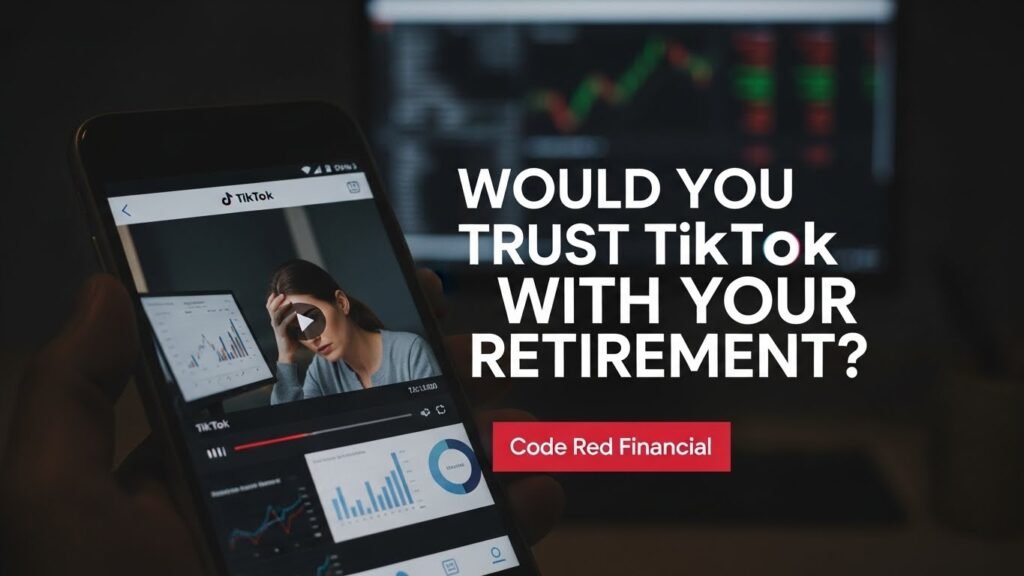
The question, “Would you trust TikTok with your retirement?” demands a nuanced answer: You can trust it to teach you, but you must not trust it to advise you.
Finfluencers have done an invaluable service by normalizing and democratizing financial education. They have solved the awareness gap, and that is a massive victory. However, robust retirement planning is not a general, one-size-fits-all concept; it is a personalized strategy built on a complex foundation of individual tax law, risk management, and long-term planning.
The very attributes that make FinTok content engaging—its brevity, its speed, and its reliance on generalized strategies—make it fundamentally unsuitable for implementing high-stakes, life-altering financial decisions.
Your future financial independence is worth more than a catchy soundbite. The ultimate smart money move is to treat FinTok as a research library, but to reserve the authority to act for a credentialed professional who is legally and ethically bound to prioritize your financial success or simply utilize other well regarded reputable sources.
Disclaimer: This article is for informational purposes only and does not constitute financial or investment advice. Consult with a qualified financial advisor or tax professional before making any decisions about your investments or retirement accounts.
Jay Sadio, MBA