On principle, I truly detest owing money to anyone. Even when pondering a home purchase, I consider paying down as much as possible or buying it outright—and no, this isn’t because I am some wealthy FinTech bro. It’s simply my personal preference.
Now I’m aware some of what I mentioned above isn’t for everyone, and buying a home with cash might not even be the best financial strategy for you and your family. But this article is about why I purchase my vehicles with cash, so I shall stay on task.
The Financial Case for Buying Used (Most of the Time)
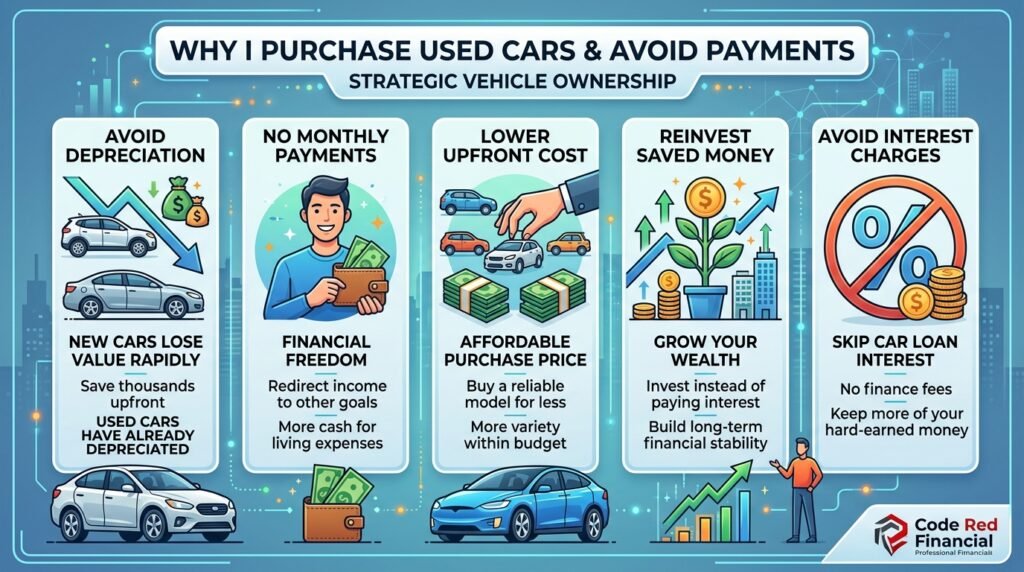
Opting to buy a preowned vehicle can be—and in most cases is—a fantastic capital preservation strategy. You’ll often get a three- to five-year-old vehicle with some warranty remaining and at a significant discount. The numbers tell a compelling story: new cars depreciate approximately 20-30% the moment you drive them off the lot, and by year three, the average vehicle has lost 40-50% of its original value.
Let’s put real numbers to this. A $35,000 new SUV will typically be worth around $24,500 after one year and roughly $19,250 after three years. That’s a $15,750 loss in just three years, or $438 per month in depreciation alone—before factoring in your actual car payment, insurance, or maintenance. When you buy that same vehicle at three years old, you let someone else absorb that brutal initial depreciation hit.
However, there are also times when you could opt for getting an older vehicle, priced at 70 or 80 percent lower than the original sales price. This obviously presents a bit more risk because of the lack of a warranty and the reality that aging components are more susceptible to malfunctions and failure.
When New Actually Makes Sense
I recently saw a 2025 Jeep Grand Cherokee with $12,000 in manufacturer and other incentives priced at $27,500, while comparable 2023 models with 25,000 miles were listed at $28,000. In this scenario, buying new gets you zero miles, a full factory warranty, and lower financing rates if you choose to finance. The math simply works better for new.
This phenomenon typically occurs when manufacturers have excess inventory, model redesigns are imminent, or economic conditions force dealers to move units.
The Sweet Spot: Three to Five-Year-Old Vehicles
In some scenarios, the three- to five-year-old vehicle represents the optimal balance between affordability and reliability. Here’s what makes this range attractive:
Warranty Coverage: Many manufacturers now offer six-year/72,000-mile powertrain warranties. A four-year-old vehicle with 48,000 miles still has two years of coverage remaining, protecting you from catastrophic repair costs.
Modern Features: Vehicles from this era include essential safety features like backup cameras, blind-spot monitoring, and advanced airbag systems that were luxury items a decade ago.
Documented History: With three to five years on the road, these vehicles have established track records. You can research common problems, check recall histories, and read owner forums to identify potential issues before purchasing.
Price Advantage: You’re still saving 40-60% compared to new while getting a relatively modern vehicle that should provide many reliable years of service.
The High-Risk, High-Reward Option: Older Vehicles
Purchasing a vehicle that’s eight to twelve years old can slash costs to 20-30% of the original price. A $40,000 luxury sedan might be available for $8,000 at ten years old. That’s an incredible discount, but not without risks.
At this age, you’re likely facing timing belt replacements ($800-$1,500 or much more), transmission services ($200-$400), suspension work ($600-$1,200), and other issues. A single major repair can equal 25% of the vehicle’s value. This strategy works best if you can turn a wrench, have a trusted independent mechanic, or substantial repair funds saved.
The Pre-Purchase Inspection: A Cautionary Tale
A pre-purchase inspection (PPI) is a good idea, but they’re not foolproof and can provide false security, based on my own experience and that of others. For instance, I once paid $150 for a PPI on a used SUV, the inspection report showed a few minor faults but nothing concerning—worn wipers, a small fluid leak, typical wear items. I was ready to proceed with the purchase.
Fortunately, I had a fortuitous break. The vehicle had received a second inspection at a different local shop before I finalized the deal. When I called the dealership, they mistook me for the person who had ordered that second inspection and provided the details to contact that shop. That shop, in turn, shared a comprehensive report revealing extensive required repairs: failing transmission mounts, deteriorating brake lines, and signs of Intake Manifold issues. The total repair estimate exceeded $5,200.
That error saved me from what would have been a devastating financial mistake, even though the first inspection had ruled out any major problems. This wasn’t an isolated incident—I’ve had other experiences where inspections missed crucial issues.
To be clear, I’m not opposed to inspections. On the contrary, I simply want you to be extra cautious. If possible, insist on having the vehicle inspected on a lift by a mechanic you trust, not one recommended by the seller. Budget $150-$200 for a thorough PPI, and consider it money well spent even if you ultimately walk away from the deal.
Where You Buy Matters: Dealerships vs. Private Party
Franchised Dealerships: These offer certified pre-owned (CPO) programs with extended warranties, thorough inspections, and reconditioning. You’ll pay 10-15% more than private party prices, but you get peace of mind and some recourse if problems arise.
Independent Dealerships: Prices often fall between franchised dealers and private sellers. Quality varies dramatically—some are reputable businesses, others are essentially car flippers with storefronts. Research reviews extensively and never skip the independent PPI.
Private Party Sales: Typically, 15-20% cheaper than dealer prices, but you assume all risk. There’s no warranty, limited recourse if problems emerge, and higher fraud potential. However, you can sometimes find well-maintained vehicles from meticulous owners who have complete service records.
Negotiation Strategies That Actually Work
Researching a vehicle purchase is much easier than it was 25 years ago and required, particularly on a used car. Using Kelley Blue Book, Edmunds, and recent sold prices for comparable vehicles in your area, although I have become leery of KBB due to the fact that they are owned by the same company of Autotrader.com and that sort of conflict of interest between the price setter and selling marketplace isn’t ideal for the buyer in my opinion.
For private sellers, offering cash and being ready to transact immediately provides tremendous leverage. For dealers, shop at month-end, quarter-end, or year-end when salespeople are desperate to hit quotas, (I am not so certain how effective this strategy still is).
One often-overlooked strategy: make your offer based on the out-the-door price, not the sticker price. This prevents dealers from playing games with fees, documentation charges, and add-ons.
Red Flags and How to Spot Fraud
Single-owner vehicles with complete service records are gold. A car with four owners in five years suggests problems. Be wary of any seller who:
- Refuses to allow an independent inspection
- Claims “my mechanic friend just looked at it”
- Has a title from a different state with no explanation
- Pressures you to decide immediately
- Won’t provide the VIN before meeting
Always run a Carfax or AutoCheck report ($40 well spent), and pay extra attention to title brands, accident history, and service records. A salvage or rebuilt title should result in a 40-50% price reduction minimum, and even then, proceed with extreme caution, it is important to understand that AutoCheck and Carfax is simply a guide, not factbook.
My Personal Maintenance Protocol
I typically investigate the known pain points of the specific vehicle I’m purchasing and address those immediately if I can. Oil changes happen virtually right away—I want to establish a baseline with fresh oil and see what comes out of the engine. Spark plugs should be replaced if there’s no documentation they’ve been done recently, which I must confess I haven’t done yet with my most recent purchase (I’m overdue).
Also be certain to immediately address any deferred maintenance the seller disclosed. If they mentioned the brakes were “getting close,” I replace them before there’s a problem.
The Aftermarket Warranty Question
Extended warranties and aftermarket protection plans rarely make financial sense for the buyer (they’re highly profitable for dealers, which tells you everything). However, they might be worth considering if you’re purchasing an older luxury vehicle known for expensive repairs, particularly European brands (Full disclosure, I don’t care for them).
If you’re buying a seven-year-old BMW with 82,000 miles, a $2,000 warranty covering major components for two years might provide valuable protection since a single repair could cost that much. For a Toyota or Honda with the same profile, skip it and bank that $2,000 for potential repairs instead.
The Car Fund Strategy: Your Secret Wealth-Building Tool
When you buy a used vehicle with cash, you eliminate the monthly payment. But here’s the critical move most people miss: you should continue “making that payment” to yourself. If you would have had a $450 monthly car payment, set up an automatic transfer of $450 into a separate, interest-bearing account dedicated exclusively to automotive expenses.
How This Works in Practice:
Let’s say you buy a $18,000 used vehicle with cash instead of financing a $35,000 new car. You’ve saved $17,000 upfront, but the real magic happens with the phantom payment strategy.
A $35,000 vehicle financed at 7% over 60 months costs $693 per month. Even if you can only contribute $400-$500 monthly to your car fund (because you’re investing or saving the rest), you’re building substantial wealth. Here’s what happens:
Year 1: $500/month × 12 = $6,000 saved
Year 2: $6,000 + $6,000 = $12,000 total
Year 3: $12,000 + $6,000 = $18,000 total
After three years, you’ve accumulated enough to buy your next vehicle outright—and you still own the first one. Meanwhile, someone financing that new car has paid approximately $25,000 toward a vehicle now worth perhaps $24,000, and they still owe $10,000.
Where to Keep Your Car Fund:
I recommend keeping this money in an interest-bearing account that’s accessible but separate from your daily banking. Here are solid options:
High-Yield Savings Account: Currently earning 4.0+ % APY at many online banks. Your $6,000 annual contribution becomes $6,150 with interest in year one, and compound interest accelerates the growth. By year five, you could have $33,800 instead of $30,000 from contributions alone.
Money Market Account: Similar rates to high-yield savings but may offer check-writing privileges. This gives you quick access when you need to purchase a vehicle or handle a major repair without wire transfer delays.
Short-Term Treasury Bills or CDs: If you’re disciplined and won’t need the money for 6-12 months, laddering short-term Treasuries or CDs can yield slightly higher returns while keeping funds relatively accessible. I ladder 3-month and 6-month positions so money is always becoming available.
What to Avoid: Don’t keep this in a standard checking or savings account earning 0.01% interest. That’s leaving hundreds of dollars on the table annually. Similarly, don’t invest this money in stocks or volatile assets—you need this capital to be stable and available when your vehicle needs arise.
Dual-Purpose Power:
Your car fund serves two critical functions that provide tremendous peace of mind:
- Repair Reserve: When your transmission service costs $350 or you need new tires at $800, you write a check from your car fund without disrupting your regular budget or touching emergency savings. This eliminates the financial stress that forces many people into predatory lending situations.
- Replacement Capital: Every month, you’re building toward your next vehicle. When your current car reaches 200,000 miles or repair costs exceed its value, you have $20,000-$30,000 ready to deploy. You’re never forced to finance because you’re unprepared.
The Discipline Factor:
The hardest part is maintaining discipline. When you have $15,000 sitting in an account, it’s tempting to “borrow” it for other purposes. Don’t. This fund is your automotive insurance policy and your ticket to permanent freedom from car payments.
I mentally categorize car fund money as already spent—it’s not available for vacations, home improvements, or investment opportunities. This money has one job: keep me mobile and independent.
Scaling the Strategy:
Your contribution should match your realistic car payment budget, not what you think sounds impressive. Contributing $300 monthly is infinitely better than contributing $600 for three months and then stopping.
If money is tight, even $150-$200 monthly builds $7,200-$9,600 over four years—enough for a solid older vehicle or a substantial down payment that minimizes any financing needed. The key is consistency and treating it like the non-negotiable payment it would be if you owed a lender.
Advanced Move – The Two-Fund System:
Once your car fund reaches your target vehicle price (for me, that’s $20,000-$25,000), I split contributions: 50% continues building the car fund for the next vehicle, and 50% flows into actual investments. This approach means you’re simultaneously preparing for your next car while building long-term wealth.
For example, if you’re contributing $500 monthly and hit your $22,000 target, start directing $250 to continue building the car fund and $250 to index funds or retirement accounts. When you eventually need to buy your next vehicle, you’ll have accumulated another $15,000-$18,000 in the car fund (depending on timing) plus you’ve started building investment wealth that compounds over decades.
The Bottom Line
Buying used vehicles with cash has allowed me to avoid the monthly payment trap that keeps many Americans living paycheck to paycheck. The average new car payment now exceeds $730 per month for 68 months—that’s nearly $50,000 committed to a depreciating asset.
If you have made to the end of the article, congrats, I know it was longer than my usual post but, I wanted to ensure that I provided as much crucial information as possible
Disclaimer: This article is for informational purposes only and does not constitute financial or investment advice. Consult with a qualified financial advisor or tax professional before making any decisions about your investments or retirement accounts.
Jay Sadio, MBA