

Was it Just a Trap?
Picture this: It’s 1975. Dad goes to work. Mom stays home. There’s a house, two kids, a car, a vacation every summer, and enough left over to save for retirement. One paycheck. Middle-class comfort. Stable.
Now fast-forward fifty years. Both parents work full time. Two incomes, two commutes, two LinkedIn profiles, one daycare bill that costs more than a mortgage. And somehow — somehow — it still feels like there’s never quite enough.
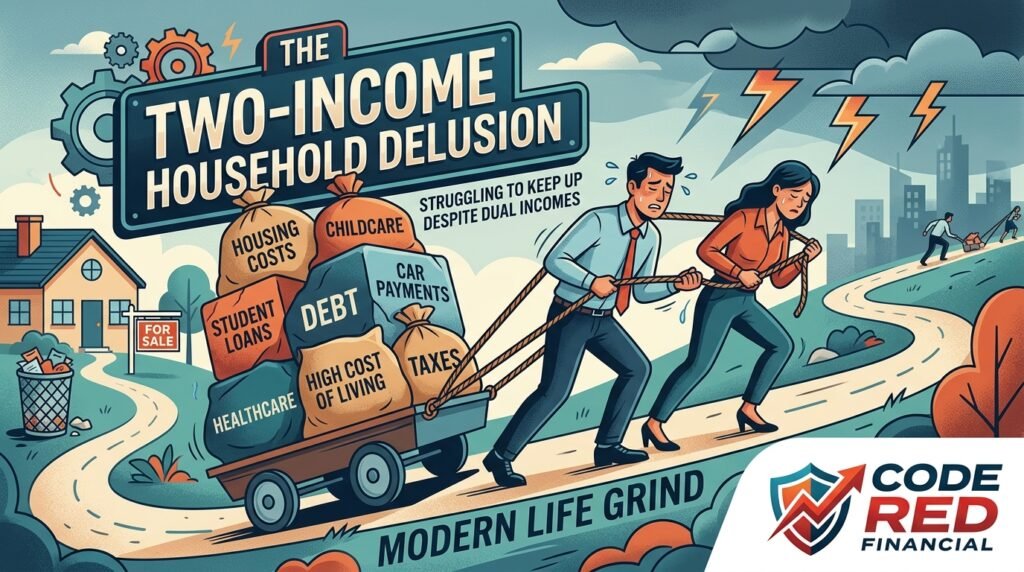
How did we get here? And was this transition from one income to two ever really about freedom, prosperity, and gender equality? Or was something far more insidious at work?
The uncomfortable answer is: probably both. But one of the parts that irritate me is how the “two-income trap” quietly devoured the gains it promised — and left the American middle class running twice as hard just to stay in place.
“We didn’t gain a second income. We lost the ability to survive on one.”
The One-Income World That Used to Work
Let’s start with the numbers, because they’re genuinely shocking when you line them up side by side.
In 1960, the median household income in the United States was approximately $5,600 per year — almost entirely earned by a single male breadwinner. The median home price was around $11,900. That means a family could buy a house for roughly 2.1 times their annual income.
Today, the median household income sits around $74,580 — but now it typically takes two earners to hit that number. The median home price? Around $420,000. That’s 5.6 times the median household income — even with both spouses working.
1960 home price-to-income ratio: 2.1x (single income) 2024 home price-to-income ratio: 5.6x (dual income) Real wage growth for median workers since 1970: ~15–20% (inflation-adjusted) Increase in housing costs since 1970: ~400% (inflation-adjusted)
The math is brutal. A single-earner family in 1970 could afford a home, a car, healthcare, and save for retirement. A dual-earner family in 2024 is often stretched thin doing the same. Something went very, very wrong.
The Great Absorption: Where Did the Second Income Go?
The brilliant — and devastating — insight from Harvard bankruptcy professor and now Senator. Elizabeth Warren and her daughter Amelia Tyagi in their 2003 book The Two-Income Trap was this: the second income wasn’t spent on luxuries. It was absorbed. By the way, I thought the book was very insightful and thought provoking.
When women entered the workforce en masse in the 1970s and 80s, household incomes rose. But so did competition — for everything. Homes in good school districts. Reliable cars for two commuters. Childcare. And markets, being efficient little machines, priced all of it accordingly.
The second paycheck didn’t make families richer. It made the baseline more expensive — and then locked them into needing both incomes just to meet it.
Here’s what the second income actually got spent on, on average:
Federal and state income taxes on second earner: +$8,000–$15,000/year Childcare (national average, two kids): +$20,000–$40,000/year Second vehicle (payments, insurance, fuel): +$8,000–$12,000/year Work-related clothing, meals, convenience: +$3,000–$6,000/year Net gain from second income (median estimate): $15,000–$30,000/year
For many middle-class families, the actual financial benefit of the second income — after taxes and work-related costs — is surprisingly modest. You’re working 40+ hours a week for what amounts to a part-time wage once all the expenses stack up.
The Bidding War Nobody Invited You To
Here’s where it gets really uncomfortable. The two-income household didn’t just break even — it helped inflate the very assets that defined middle-class security, pricing out the families still trying to get in.
When dual incomes became the norm, mortgage lenders didn’t shrug and say “great, these families can pay off their homes faster.” They said: “Great — these families can borrow more.” Banks began qualifying borrowers based on combined household income. Home prices rose to reflect what dual-income families could afford to pay.
The result? A massive, slow-motion bidding war where the prize — a home in a decent school district — kept getting more expensive because everyone competing had two incomes to throw at it. Single-income households, whether by circumstance or choice, got left behind. And dual-income households ended up spending just as high a percentage of their paychecks as single-income households did in 1970.
You ran faster. The treadmill sped up. Net displacement: zero.
What Actually Changed (And What Was Lost)
To be clear: women entering the workforce was a necessary, hard-won, and profoundly important social shift. The problem isn’t that women work. The problem is that an economic system absorbed those gains, redistributed them upward, and handed families back a bill.
Financial resilience collapsed. The single-income family had a secret weapon: optionality. If Dad got sick, Mom could go to work. If the economy crashed, you had a reserve lever to pull. Today’s dual-income household has no such buffer. Both earners are already deployed. One job loss doesn’t cut income in half — it triggers a crisis.
The time poverty problem exploded. Two incomes means two jobs, two commutes, two sets of workplace demands — and the same 24 hours in a day. Something had to give. It was usually sleep, community, home cooking, and time with children. The social and psychological costs of this are well-documented and rarely factored into the “household income” line.
Retirement security eroded. Despite higher nominal incomes, savings rates declined from roughly 12% in the early 1970s to hovering near 3–5% today. More income was coming in — and more was going out, leaving proportionally less to save.
“The middle class didn’t get richer when women went to work. They got leveraged.”
The Numbers That Should Keep You Up at Night
Two-income families living paycheck to paycheck (2023): ~60% Median emergency savings (U.S. households): Less than $1,000 Bankruptcies involving job loss or medical crisis: ~70% Real median male wage growth, 1979–2023: ~6% total (inflation-adjusted) Increase in household debt, 1980–2023: Over 1,000%
These are not numbers from an economy that doubled its workforce and doubled its prosperity. These are numbers from an economy that extracted a second income from families and gave them roughly the same standard of living their parents had — with far more financial exposure.
So Was It a Trap? The Honest Answer.
Yes. And no. And it depends on who you were.
For high-income, high-education dual-earner couples — two lawyers, two engineers, two doctors — the two-income household has been transformationally wealth-building. Their combined incomes vastly exceed their inflated cost structure, and they’ve accumulated real assets.
For the median American household? It was closer to a treadmill than a ladder. The second income raised the floor of what “middle class” required, bid up the assets that defined it, and then taxed, childcared, and commuted away much of what was left. The freedom it promised was real — but so was the financial trap it built.
The cruelest part: there’s no going back. The cost structure of modern middle-class life now assumes two incomes. You can’t opt out. You’re already in the game.
The two-income household didn’t expand the American Dream. For most families, it just made the Dream require two people to fund what one person used to.
What You Can Actually Do With This
Understanding the trap is the first step to not being fully consumed by it.
Live on one income if at all possible. Even temporarily. Build your lifestyle around the lower earner’s salary and bank the rest. This is the single greatest financial resilience move available to a dual-income couple.
Treat the second income as an investment vehicle, not a lifestyle fund. Direct it to debt elimination, retirement accounts, and assets — not to a larger house or a second car payment.
Question the school district premium. The biggest driver of housing cost inflation is the race for “good” school districts. Private school tuition in a cheaper neighborhood can sometimes cost less than the mortgage premium on a house in the “right” zip code. Run the actual numbers.
Audit your work costs honestly. Childcare, commuting, convenience food, work clothing — subtract these from the second income and see what you’re actually netting. For some families, one parent reducing hours or working remotely yields more real income than it appears to cost.
The two-income deception isn’t a conspiracy. It’s what markets do — they absorb capacity and price accordingly. But knowing that the game was rigged from the start? That’s worth something. Because the first step to building wealth in a system like this isn’t working harder.
It’s working smarter than the system expects you to, that is the key and not merely working hard. The average construction worker will work much harder than most of us will ever fathom and yet many will not truly taste of the fruit of unfettered wealth.
Share this article if it made you think differently about how you work and earn.
Disclaimer: This article is for informational purposes only and does not constitute financial or investment advice. Consult with a qualified financial advisor or tax professional before making any decisions about your investments or retirement accounts.
Jay Sadio, MBA