How the Wealth Disparity is Crushing People Across the Globe
The chasm between the ultra-wealthy and everyone else isn’t just widening—it’s becoming a canyon that threatens the very fabric of our global society. While billionaires launch themselves into space and purchase social media platforms on a whim, millions of families worldwide struggle to afford basic necessities. This isn’t just an economic statistic; it’s a human crisis unfolding in real-time across every continent.
The Numbers That Tell a Devastating Story
Let’s talk about what wealth inequality actually looks like in concrete terms. The world’s richest 1% now own nearly half of all global wealth, while the bottom 50% of humanity shares just 2% of the pie. If you think that sounds abstract, consider this: the combined wealth of the world’s billionaires increased by $3.9 trillion during the pandemic years alone, while over 160 million people were pushed into poverty.
These aren’t just numbers on a spreadsheet—they represent real families making impossible choices between medication and groceries, education and electricity, dignity and survival. The wealth gap has reached levels not seen since the Gilded Age, and unlike that era, today’s inequality operates on a truly global scale.
How We Got Here: The Perfect Storm
The roots of our current crisis run deep and intertwine like a complex web. Globalization promised prosperity for all but delivered it primarily to those who owned capital rather than those who provided labor. Manufacturing jobs that once sustained middle-class families in developed nations disappeared overseas, while the workers in those new manufacturing hubs often labored for poverty wages without meaningful protections.
Technology accelerated this divide at breakneck speed. The digital revolution created unprecedented fortunes for a select few while automating away millions of jobs that provided economic stability for generations. A software engineer at a tech giant might earn hundreds of thousands annually, while the person delivering their packages struggles on gig economy wages with no benefits or job security.
Tax policy played an equally crucial role. Across the globe, governments competed to attract wealthy individuals and corporations by slashing tax rates, creating loopholes, and allowing the establishment of offshore tax havens. The result? The effective tax rates paid by billionaires often fall below those paid by middle-class workers. When the wealthy don’t contribute their fair share, public services deteriorate, infrastructure crumbles, and social mobility—the promise that hard work leads to better outcomes—becomes increasingly mythical.
The Human Toll: Beyond Statistics
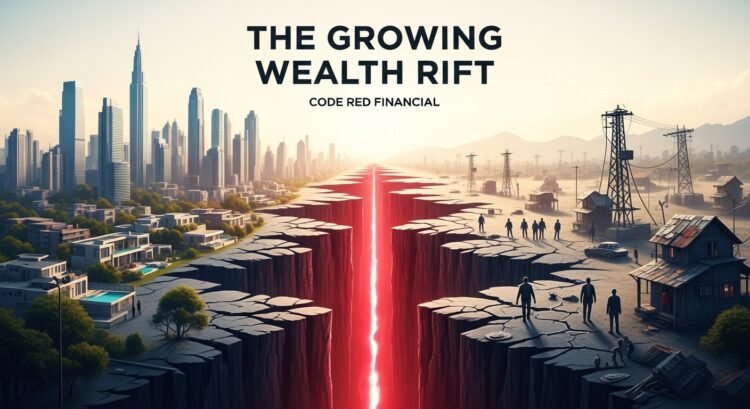
Walk through any major city today, and you’ll see the stark visual evidence of inequality. Gleaming luxury condos tower over homeless encampments. Designer boutiques stand mere blocks from food banks with lines stretching around corners. This isn’t just happening in developing nations—it’s the reality in London, Los Angeles, São Paulo, and Sydney.
The psychological impact cuts even deeper than the economic hardship. Research consistently shows that societies with higher inequality experience more mental health problems, higher rates of substance abuse, and greater social dysfunction. When people feel they have no stake in the system, when they watch their children’s opportunities diminish while others inherit dynasties, something fundamental breaks in the social contract.
Young adults face a particularly cruel reality. The promise that education would unlock opportunity has become a cruel joke for millions drowning in student debt while competing for jobs that don’t pay enough to afford the neighborhoods where those jobs are located. Home ownership—once the cornerstone of middle-class wealth building—has become a distant dream for entire generations.
The Ripple Effects on Democracy and Social Stability
Perhaps the most insidious consequence of extreme wealth inequality is its corrosive effect on democratic institutions. When a tiny fraction of society controls the majority of resources, they inevitably wield disproportionate political power. Campaign contributions, lobbying efforts, and the ability to shape public discourse through media ownership all tilt the playing field toward those who already have everything.
This creates a vicious cycle: wealth translates into political influence, which shapes policies that further concentrate wealth, which generates more political power. Meanwhile, ordinary citizens watch their votes and voices matter less and less, breeding cynicism, anger, and a susceptibility to populist movements that promise to burn the system down rather than reform it.
Social unrest isn’t a hypothetical future concern—it’s happening now. From the Yellow Vest protests in France to demonstrations in Chile, from unrest in Sri Lanka to strikes across numerous industries in wealthy nations, people are increasingly refusing to accept a system rigged against them. History teaches us that societies cannot maintain extreme inequality indefinitely without experiencing upheaval.

Why Traditional Solutions Keep Failing
Governments have tried various approaches to address inequality, yet the problem persists and often worsens. Minimum wage increases help but rarely keep pace with the rising cost of living, particularly housing. Education initiatives promise opportunity but can’t overcome the massive advantages that wealth confers from birth—private tutors, legacy admissions, unpaid internships that only the affluent can afford.
Social safety nets strain under increasing demand while facing political attacks and budget cuts. Meanwhile, the wealthy have become increasingly adept at protecting and growing their fortunes through sophisticated financial instruments, global mobility, and armies of tax attorneys and wealth managers. For every policy designed to address inequality, there are dozens of workarounds available to those who can afford expert advice.
The fundamental problem is that we’re trying to solve a structural issue with superficial fixes. Wealth doesn’t just provide material comfort—it compounds over time through investment returns, access to better opportunities, and the ability to take risks that workers living paycheck-to-paycheck simply cannot afford. Without addressing these structural advantages, incremental policies merely slow the rate at which inequality grows rather than reversing it.
The Business Case for Addressing Inequality
Here’s something that should concern even those who benefit most from the current system: extreme inequality is economically inefficient. When wealth concentrates at the top, it reduces overall economic demand. The wealthy can only buy so many cars, houses, or meals. A thriving economy needs a robust middle class with purchasing power.
Companies increasingly struggle to find customers who can afford their products and workers healthy and educated enough to fill positions. Infrastructure deteriorates when tax revenue shrinks, making business operations more difficult. Social instability threatens supply chains and markets. Even from a purely self-interested perspective, the ultra-wealthy should recognize that you can’t have a stable, prosperous society when the majority feel increasingly desperate and angry.
What Real Change Requires
Addressing wealth inequality demands bold, structural reforms, not incremental tweaks. Progressive taxation that actually makes the wealthy contribute proportionally to their gains. Closing offshore tax havens and ending the shell game that allows wealth to hide from taxation entirely. Strengthening labor rights so workers can bargain collectively for fair wages and conditions.
Investment in public goods—education, healthcare, infrastructure, housing—that don’t require wealth to access. Policies that encourage wealth building among working families, like down payment assistance, subsidized retirement accounts, and programs that help workers become owners rather than merely employees. Regulation of corporations that prioritize quarterly profits over worker welfare and long-term sustainability.
Perhaps most importantly, we need a fundamental shift in how we think about wealth and success. The myth of the self-made billionaire ignores the public infrastructure, educated workforce, legal systems, and stable society that enabled that wealth creation in the first place. Asking those who have benefited most to contribute their fair share isn’t class warfare—it’s basic social responsibility.
The Choice Before Us
The wealth gap isn’t an inevitable natural phenomenon like gravity—it’s the result of policy choices, economic structures, and social norms that we collectively maintain. That means we can collectively change them, if we find the political will to do so.
We stand at a crossroads. One path leads to ever-greater inequality, social fragmentation, and eventual upheaval. The other requires hard choices and political courage but offers a more stable, prosperous, and just society for everyone—not just those at the top.
The growing rift of wealth inequality is crushing people across the globe, but it doesn’t have to be permanent. History shows that societies can choose to prioritize broad-based prosperity over concentrated wealth. The question isn’t whether we have the resources or knowledge to address this crisis—we clearly do. The question is whether we have the collective will to make different choices before the cost becomes catastrophic.
The clock is ticking, and with each passing year, the divide grows deeper and the challenge more daunting. But awareness is the first step toward change, and more people than ever recognize that the current trajectory is unsustainable. What happens next depends on what we do with that awareness—whether we channel it into meaningful action or watch helplessly as the rift continues to widen until something breaks.
Disclaimer: This article is for informational purposes only and does not constitute financial or investment advice. Consult with a qualified financial advisor or tax professional before making any decisions about your investments or retirement accounts.
Jay Sadio, MBA