Surviving the End of the “Borrowed Growth” Era
Most market participants are currently fixated on the “noise”—the intraday volatility of the S&P 500, the quarterly earnings of the latest AI hardware giant, or the tactical phrasing of the Federal Reserve’s latest press release. These are the distractions of the surface. But underneath the daily churn, a tectonic shift is occurring. It is a transformation driven by a number so massive it has become abstract to the human mind, yet it is the primary force shaping everything from your mortgage rate to the price of a gallon of milk.
As of early 2026, the combined debt of the U.S. government, corporations, and households has breached levels that were once considered the realm of economic fiction. We have built a global superpower on a foundation of borrowed time and borrowed money. For the first time in three generations, the cost of carrying that debt is growing faster than the economy itself.
We are no longer just “overspending.” We are witnessing a fundamental shift in the mechanics of the Western economy: the transition from a system of wealth creation to a system of debt maintenance.
1. The Triple Threat: Why This Cycle is Different
In previous economic cycles, leverage was usually concentrated in one sector. In the late 1990s, it was corporate speculation in tech. In 2008, it was household mortgage debt. Today, we are facing a “Polycrisis” where all three major pillars of the economy—Government, Corporate, and Household—are hitting record extremes simultaneously.
I. The Sovereign Debt Spiral ($38 Trillion and Beyond)
In late 2025, the U.S. National Debt officially surged past $38 trillion. While that number is staggering, the total debt is less important than the interest expense.
For decades, falling interest rates allowed the government to borrow more while paying less to service that debt. That era is over. As of 2026, interest payments on the national debt have eclipsed $1.1 trillion per year. To put that in perspective:
- It is more than the entire U.S. Defense budget.
- It is more than the total spending on Medicaid.
- It represents roughly 15–20% of all federal tax revenue.
When such a massive portion of the “national paycheck” goes toward interest, the government loses its ability to respond to emergencies. Whether it’s a natural disaster, a geopolitical conflict, or an economic downturn, the fiscal “ammunition” is gone. We are now in a position where the U.S. must borrow money just to pay the interest on the money it already borrowed. This is the classic definition of a debt spiral.
II. The “Zombie” Corporate Landscape
Between 2010 and 2021, we lived through a period of “financial repression”—interest rates were kept near zero. This allowed “Zombie Companies” to flourish. These are firms that do not generate enough profit to cover their debt interest payments and must constantly issue new debt to stay afloat.
In 2026, the bill has come due. As these companies are forced to refinance their old, cheap debt at current rates of 7% or 8%, their profit margins are being eviscerated.
- The Productivity Tax: These companies don’t necessarily go bankrupt in a spectacular explosion. Instead, they become a drag on the economy. They cannot afford to hire, they cannot afford R&D, and they cannot innovate.
- The Layoff Trigger: As the “interest wall” hits, these firms are forced to cut their only variable cost: human labor. This creates a slow-motion cooling of the labor market that the Fed finds difficult to restart.
III. The Household Breaking Point
For the American middle class, the “Debt-to-Income” ratio has reached a psychological breaking point. For decades, debt was a tool used to buy assets (homes, education). Today, debt is being used to subsidize basic survival.
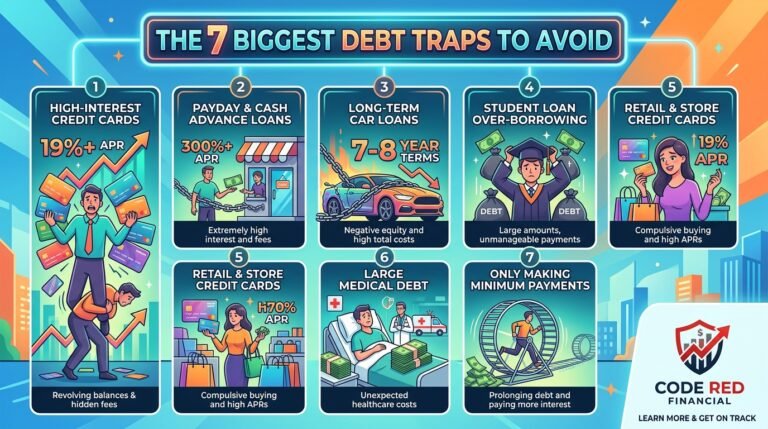
- Credit Card Dependency: Credit card balances have hit all-time highs as families use revolving credit to cover “non-discretionary” costs—groceries, utilities, and insurance premiums—which have remained high despite cooling headline inflation.
- The Interest Trap: With average credit card APRs hovering near 25%, a family carrying a $10,000 balance is effectively paying a $2,500 annual “tax” just for the privilege of existing. This drains the “velocity of money,” as that capital never makes it back into the productive economy.
2. The Psychology of “Debt Blindness”
Why isn’t this the only thing people are talking about? Behavioral economics suggests we suffer from Normalcy Bias. Because the system hasn’t collapsed yet, we assume it never will.
We treat the debt like a “Gray Rhino”—an elephant-sized threat that is moving slowly enough that we feel we can jump out of the way at the last second. But debt is a mathematical certainty, not a political opinion. Eventually, the interest exceeds the ability to pay. When that happens, the system undergoes a “Reset.”
3. The Three Paths of the Great Reset
History shows that when a nation’s debt-to-GDP ratio exceeds 120% (as the U.S. has), there are only three exits.
Scenario A: Financial Repression (The “Soft” Reset)
This is the most likely path. The government and the central bank work in tandem to keep interest rates lower than the rate of inflation.
- The Goal: To let inflation “burn off” the debt. If inflation is 5% but the government only pays 3% on its debt, the “real” value of that debt shrinks every year.
- The Cost to You: This is a hidden tax on savers. Your bank account balance stays the same, but your purchasing power evaporates. This is how the middle class is quietly liquidated to pay for the errors of the state.
Scenario B: The Sovereign Default (The “Hard” Reset)
A formal default—where the U.S. simply says “we won’t pay”—is highly unlikely because the U.S. borrows in its own currency. They can always print more. However, a “de facto” default can happen through a massive currency devaluation or a restructuring of entitlement programs (Social Security/Medicare).
- The Consequence: A loss of the U.S. Dollar’s status as the world’s reserve currency. If the world stops trusting the dollar, the cost of everything we import (from iPhones to oil) skyrockets overnight.
Scenario C: The CBDC Transition
Some analysts believe the reset will be technological. By moving to a Central Bank Digital Currency (CBDC), the government could gain the power to implement “targeted” economic moves.
- The Mechanism: They could theoretically “forgive” certain classes of student or medical debt while simultaneously devaluing the old “paper” dollar, forcing everyone into a new, fully tracked digital system where interest rates can be moved into negative territory to force spending.
4. The Anti-Fragile Blueprint: How to Position Yourself
You cannot control the $38 trillion national debt, but you can control your “personal economy.” To survive a debt reset, you must move from being a consumer of credit to an owner of assets.
Step 1: Eliminate “Financial Quicksand”
In a high-interest world, carrying debt is the equivalent of running a race with lead weights in your shoes.
- The 20% Rule: Any debt with an interest rate above 10% must be treated as a house fire. Paying off a 24% credit card is a guaranteed 24% return. You will not find that in the stock market.
- Action: Use the “Debt Snowball” or “Avalanche” method to clear all consumer debt. Be ruthless.
Step 2: Build a Fortress of “Hard” Assets
If the “Soft Reset” (inflation) is the path forward, paper money will continue to lose value. You must own things that cannot be printed.
- Real Estate (Fixed Rate): A 30-year fixed-rate mortgage is one of the few ways the average person can benefit from inflation. You are paying back the bank with “cheaper” dollars 20 years from now.
- Commodities and Gold: Gold has been the ultimate “reset” insurance for 5,000 years. It doesn’t pay a dividend, but it also doesn’t have a “counterparty risk”—it isn’t someone else’s liability.
- Digital Scarcity (Bitcoin): As of 2026, Bitcoin is no longer a fringe experiment. It is increasingly viewed by institutional investors as a “port of exit” from the legacy financial system. Its hard cap of 21 million units makes it the antithesis of the $38 trillion (and growing) dollar supply.
Step 3: Maintain “Opportunity Capital”
While you don’t want to hold all your wealth in cash, you need liquidity.
- The Dry Powder Strategy: When a debt reset occurs, it often triggers a “liquidity crunch” where even good assets (like great stocks) get sold off because people need cash to pay debts.
- Action: Keep 6–12 months of living expenses in a High-Yield Savings Account. This isn’t just an “emergency fund”—it is your “opportunity fund” to buy assets at a 50% discount when the zombies start to fall.
5. Summary: From Passive Victim to Active Owner
The debt crisis isn’t a secret; it’s a math problem that politicians are hoping they can outrun. But the “Gray Rhino” is getting closer.
The coming decade will be defined by a massive transfer of wealth. It will move away from those who hold “paper” promises (savings accounts, bonds, and pensions that aren’t inflation-adjusted) and toward those who hold real, scarce assets.
The American Dream isn’t dead, but the version of it that was powered by an endless supply of cheap credit is gone. The new path to prosperity requires a different set of rules:
- Trust math over rhetoric.
- Prioritize ownership over consumption.
- Protect your purchasing power, not just your balance.
The debt trajectory is clear. The question is: will you be part of the collateral damage, or will you be positioned to thrive in the new economy?
Is Your Portfolio Ready for a Debt Shock?
The first step to safety is knowing your Contagion Risk. This is the measure of how much of your lifestyle depends on the very debt-heavy systems that are currently under strain.
Disclaimer: This article is for informational purposes only and does not constitute financial or investment advice. Consult with a qualified financial advisor or tax professional before making any decisions about your investments or retirement accounts.
Jay Sadio, MBA