How to Recognize Them, Escape Them, and Protect Your Financial Future
Virtually nobody wakes up one morning and thinks, “You know what? Today’s a great day to fall into crippling debt.” And yet, millions of people find themselves trapped in this sort of perpetually cycle — sometimes slowly, sometimes overnight — in financial holes that feel like an impossible vacuum to climb out of.
Interestingly and perhaps most frustratingly is that most debt traps don’t look like traps at all. They look like opportunities. A shiny new credit card with a tempting intro rate. A car loan at the time that appears to fit “comfortably” into your monthly budget. A payday loan that promises a quick fix to a temporary “that situation” and by the time the real cost becomes clear, you find yourself waist deep in a debt laden quagmire.
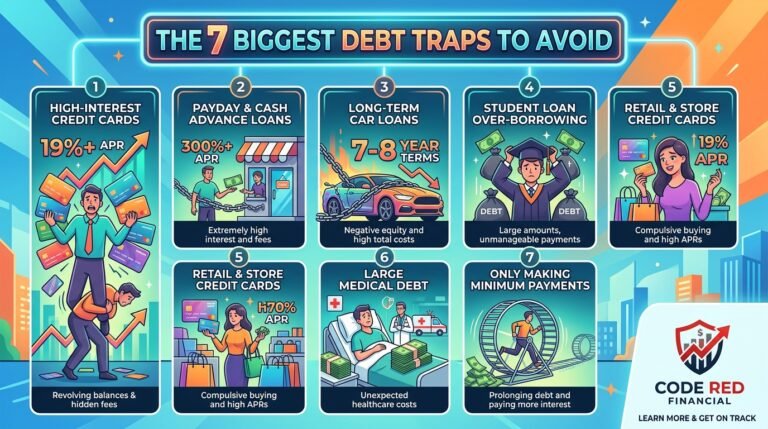
The good news: awareness is your most powerful weapon. Once you know what these traps look like, you can spot them coming from a mile away. Here are the 7 biggest debt traps — and exactly how to avoid them.
Debt Trap #1: The Payday Loan Spiral
Payday loans are marketed to people who are already struggling — and that’s exactly what makes them so dangerous. These short-term loans promise fast cash with minimal requirements, but they come with annualized interest rates that can reach 400% or higher.
Here’s how the trap springs: you borrow $300 to cover rent. Two weeks later, you owe $345 — but you still don’t have the money. So you roll it over. Then again. Before long, you’ve paid back twice the original loan and still owe the principal.
The Fix: Build even a small emergency fund — $500 to $1,000 — as your first financial priority. If you’re already in the cycle, contact a nonprofit credit counselor. Many offer free help navigating payday debt.
Debt Trap #2: Minimum Payment Mentality
Credit card companies are masters of psychology. That minimum payment — usually 1–3% of your balance — is designed to keep you paying interest for as long as possible. It’s not a lifeline. It’s a leash.
Example: Carry a $5,000 balance at 22% APR and only make minimum payments? You’ll be paying it off for over 15 years and shelling out thousands in interest alone.
The trap feels manageable because the monthly number is small. But the long-term cost is enormous.
The Fix: Always pay more than the minimum. Even an extra $50/month can cut years off your repayment and save hundreds in interest. Use an online debt payoff calculator to see your numbers in black and white — it’s sobering but motivating.
Debt Trap #3: Buy Now, Pay Later (BNPL) Overload
Buy Now, Pay Later services like Klarna and Afterpay have exploded in popularity — and for good reason. Zero interest, split into easy installments, no credit check. What’s not to love?
The danger isn’t any single BNPL purchase. It’s the accumulation. Studies show that BNPL users tend to spend significantly more than they would otherwise — and juggling multiple overlapping payment schedules is a recipe for missed payments, fees, and budget chaos.
The Fix: Treat BNPL like a credit card. Only use it if you could afford to pay the full amount today. If you can’t, it’s not a payment plan — it’s debt with extra steps.
Debt Trap #4: Car Loans Stretched Too Long
Car dealerships have perfected the art of the monthly payment. “Only $299 a month!” sounds great — until you realize you’re signing up for an 84-month loan on a vehicle that will be worth half its value in three years.
Long loan terms mean you spend years underwater — owing more than the car is worth. If you need to sell or the car gets totaled, you’re stuck paying off a car you no longer own.
Add on dealer-installed extras, extended warranties, and gap insurance pushed at signing, and that “affordable” monthly payment becomes a very expensive commitment.
The Fix: Keep auto loan terms to 48–60 months maximum. Aim to put 10–20% down to avoid going underwater immediately. And always negotiate the total price — not the monthly payment.
Debt Trap #5: Student Loan Inertia
Student loans are unique because they’re taken on before most people have any real sense of what debt means. At 18, borrowing $40,000 feels abstract. At 28, making $35,000 a year, it feels very real.
The trap here is inertia — putting loans on income-driven repayment or deferment without ever making a dent in the principal. Interest accrues. The balance grows. A $30,000 loan becomes $45,000 even after years of payments.
It’s easy to feel helpless, so many borrowers simply… don’t engage. That disengagement is the trap itself.
The Fix: Know your loan types, interest rates, and forgiveness options. Federal loans have real programs — SAVE, PSLF, IBR — that many borrowers don’t use because they don’t know about them. Knowledge here is literally money.
Debt Trap #6: Home Equity as an ATM
Your home’s equity is real wealth — and treating it like a piggy bank is one of the fastest ways to erode it. Home equity loans and lines of credit (HELOCs) can be smart tools for genuine investments like renovations that add value. But too often, they’re used to fund vacations, consolidate consumer debt, or float lifestyle spending.
The problem: you’re converting unsecured consumer debt into debt secured by your home. If life gets hard and payments stop, the consequences are no longer a dinged credit score — they’re foreclosure.
The Fix: Reserve home equity borrowing for value-adding improvements or genuine emergencies. Ask yourself: “Would I be comfortable explaining this purchase to my future self if the housing market dipped?”
Debt Trap #7: The Debt Consolidation Loop
Debt consolidation loans can be genuinely helpful — but only if you treat the root cause, not just the symptoms. Here’s what often happens instead: someone rolls $15,000 in credit card debt into a personal loan at a lower rate. Relief washes over them. The credit cards are paid off.
Then, slowly, the cards start filling back up. Now they have the consolidation loan AND new credit card debt. They’ve doubled their problem.
Consolidation isn’t a cure. It’s a tool. And like any tool, it can build something great or cause serious damage depending on how it’s used.
The Fix: Before consolidating, freeze the cards — literally or figuratively. Address the spending habits that created the debt. Consolidation only works if you close the loop behind you.
The Bottom Line: Debt Isn’t the Enemy — Ignorance Is
Debt, used strategically, is a powerful tool for building wealth. A mortgage on a well-priced home. Student loans that fund a degree with strong earning potential. A business loan that generates returns. These aren’t traps — they’re investments.
The traps on this list share a common thread: they obscure the real cost of borrowing. They present short-term relief or convenience while quietly extracting long-term value.
The antidote is simple, if not always easy: slow down before you sign. Ask what this debt will actually cost you — in total dollars, not monthly payments. Build an emergency fund so desperation never forces your hand. And when in doubt, talk to a fee-only financial advisor or nonprofit credit counselor who has no stake in what product you choose.
Your financial future is built one decision at a time and thus it is prudent to ensure that whatever decisions we make today are examined carefully and objectively because your future self-deserve that much. Expose yourself to as much financial education as possible and perhaps the most significant thing to learn are the fundamentals. The present and future value of money.
Sign up for budgeting apps, if possible, but I would advise against relying too much on the financial influencers of YouTube and other digital platforms as your only source of information. However, it is important to note that great information exist on many of these platforms, so spotting the difference is essential.
And finally, set clear goals, rather than saying you will save 15k this year, you must first establish the “how” you will accomplish that target.
Found this helpful? Share it with someone who could use a financial reality check.
Disclaimer: This article is for informational purposes only and does not constitute financial or investment advice. Consult with a qualified financial advisor or tax professional before making any decisions about your investments or retirement accounts.
Jay Sadio, MBA