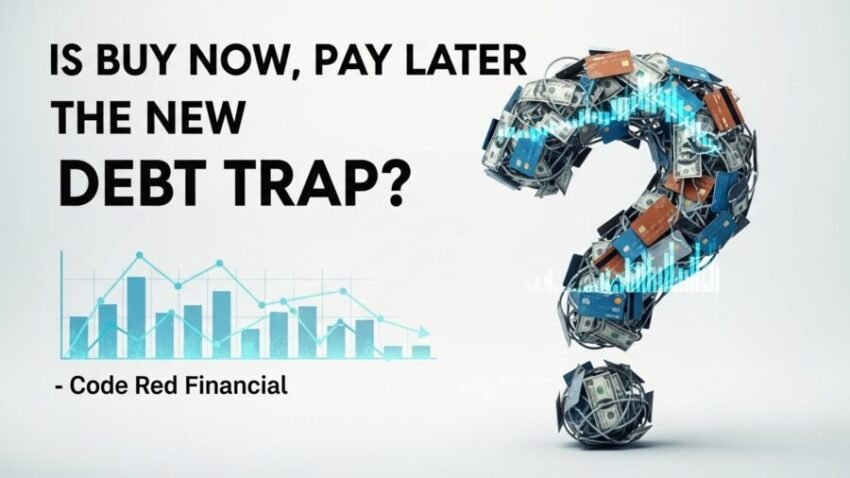
How Hidden Fees & Credit Risks are Stacking Against Gen Z
Buy Now, Pay Later promises financial freedom and savvy budgeting, but for a generation already facing high costs and economic uncertainty, the easy “Pay in 4” button is quickly becoming a financial cage.
The checkout page of your favorite online retailer is a carefully curated landscape. You’ve found the perfect pair of sneakers, the must-have tech gadget, or tickets to that once-in-a-lifetime festival. Just before you hit the final “Submit Order” button, a friendly, pastel-colored prompt appears: “Pay in 4 interest-free installments.”
It’s the ultimate pitch of modern convenience: instant gratification, zero-percent interest, and the feeling of smart, flexible budgeting. It’s called Buy Now, Pay Later (BNPL), and for many, especially those in Gen Z, it feels like a welcome alternative to the high-interest, opaque world of traditional credit cards.
But behind the slick user interfaces and the promise of financial ease, a darker reality is emerging. For a generation already grappling with student loans, soaring inflation, and a tight housing market, BNPL is not the budgeting savior it claims to be. It is, in fact, an expertly engineered financial trap—a new form of debt that is dangerously easy to accumulate, hard to track, and increasingly punitive when payments are missed.
This article will break down the BNPL illusion, revealing the systemic risks, the quiet stacking of “mini-loans,” the hidden impact on credit scores, and the crucial financial literacy gap that is turning a generation of savvy digital natives into a generation of accidental debtors.
Instant Gratification: Why BNPL is So Addictive
To understand the BNPL problem, you first have to understand its irresistible appeal, particularly to consumers born after 1997.
The Credit Card “Ick”
Gen Z came of age watching their Millennial predecessors struggle under the weight of the 2008 recession and astronomical student loan debt. As a result, many view traditional credit cards with a deep-seated suspicion, even calling it the “ick.” The idea of revolving debt, compounding interest, and surprise annual fees feels like an antiquated system built to keep them in debt.
BNPL providers like Afterpay, Klarna, and Affirm stepped into this void, offering a product that seemed to solve all the traditional credit card’s problems:
- Zero Interest (Usually): The core product—the “Pay in 4” model—is typically interest-free, as long as you pay on time.
- No Hard Credit Check: The initial application often requires only a “soft” credit pull, making it accessible to young adults with little to no credit history.
- Perceived Control: Spreading a $200 purchase into four $50 payments feels manageable and responsible, especially when living paycheck-to-paycheck.
It’s an entirely new financial behavior loop, one built on the principle of “painless payment.” Behavioral economists note that BNPL is specifically designed to “numb the pain of paying.” By splitting the cost, your brain processes a $200 jacket as a series of small, low-stakes payments, making the click-to-buy moment frictionless.
Familiarity of “Store Credit” – The Old Debt Trap, Digitalized
While the technology feels revolutionary, the fundamental concept of Buy Now, Pay Later is anything but. It’s simply an ancient practice updated for the e-commerce age, and this familiarity makes it feel safe.
Listen, I remember my Grand mum sending us to the store as a kid to purchase needed items and directing us to inform the shop owner that she will pay for it later, or more specifically, to place it on her store credit, which meant, debt account. So, I suppose BNPL could be deemed somewhere similar.
That memory highlights the key difference: personal accountability versus systemic scale.
My grand mum’s arrangement with the shop owner was a human agreement, built on trust and a shared community relationship and I should note that other members of the community had a similar agreement with the shop owner. The shop owner knew my grandmother, her financial history, and the arrangement was often flexible and transparent. If my grandmother fell behind, the shop owner was likely to have a conversation, not immediately slap on a punitive late fee.
The digital BNPL ecosystem, however, is impersonal, automated, and built for scale. You don’t know the “shop owner” (the lending platform), and the platform doesn’t know you beyond your data. There is no human relationship, only a machine waiting to enforce a digital contract the moment you are late. This removes the natural human guardrails and makes it alarmingly easy to accrue debt across countless different, disconnected digital “stores.”
Rise of BNPL for Necessities, Not Just Luxuries
Initially, BNPL was used for big-ticket, discretionary items like furniture or high-end electronics. Today, the sheer accessibility of the service has pushed it into the realm of everyday essentials.
Recent data is alarming:
- Groceries and Takeout: A significant and growing percentage of BNPL users—with Gen Z leading the charge—are now using these loans for groceries, restaurant food delivery, and takeout. When you’re financing a $50 DoorDash order over four installments, it’s a clear sign of cash-flow stress, not smart budgeting.
- High Usage Rates: A LendingTree survey found that a staggering 64% of Gen Z adults (ages 18 to 28) have used a BNPL loan, with 16% having used them six or more times. Compare that to less than a third of Baby Boomers.
This widespread use for essentials proves that BNPL has crossed a dangerous threshold. It’s no longer a tool for upgrading a lifestyle, but a crutch for maintaining a basic one in the face of persistent inflation and stagnant wages.
Hidden Costs of Convenience
The BNPL model is built on an illusion of simplicity. Its dangers are rarely about the initial interest rate, but about what happens when the perfect plan inevitably goes off track.
1. The Stacking Problem: An Invisible Pile of Debt
The single greatest risk of BNPL is how easily consumers can become overextended without even realizing it. Because many BNPL companies historically didn’t report to major credit bureaus, a user could take out five or even ten “interest-free” loans across multiple providers—Affirm, Klarna, PayPal, Afterpay—all at the same time.
- Multiple Loans, One Paycheck: Research has shown that 71% of Gen Z BNPL users have had multiple active BNPL loans simultaneously, and 26% have had three or more.
- The Payment Tsunami: Each of these mini-loans has its own micro-payment schedule: $15 due on Monday, $40 on Wednesday, $22 on Friday, $60 the following Monday, and so on. Losing track is not a sign of irresponsibility; it’s an engineered inevitability of the system. In fact, one study showed that nearly one in five BNPL users admitted to losing track of their upcoming payments.
This stacking creates an invisible pile of debt. When it comes time to pay rent, the user suddenly realizes they have a hidden, fractured second rent payment due to their BNPL habit.
2. Late Fee Squeeze: Where BNPL Platforms Make Their Money
The “interest-free” label is the hook, but late fees are the trap. This is where BNPL platforms generate a significant portion of their revenue, particularly from financially vulnerable users.
- High Delinquency Rates: Nearly one-quarter of all BNPL users have made a late payment. For Gen Z, this rate is significantly higher, with one study finding that 39% of Gen Z users have paid late—the highest rate among all generations.
- The Domino Effect: A single missed payment triggers a late fee, which can be capped but still painful (for instance, up to $7 on a small Klarna purchase). Worse, this missed payment can trigger an overdraft fee from your bank if your checking account is short, effectively doubling the penalty. If you have five active loans, one bad week could lead to five late fees and five potential bank overdraft fees.
This sudden jolt of fees is often what causes the regret. A purchase that was supposed to be $100 and “interest-free” can quickly become $125 with fees, removing any perceived financial benefit.
3. Credit Score Cliff: The New Gatekeepers of Financial Health
Perhaps the most critical risk for young adults is the quiet, but accelerating, change in credit reporting.
For a long time, the only part of BNPL that touched your credit score was if the provider sent your account to collections after a serious, prolonged default. Your timely payments didn’t help, but your failure hurt you. This is changing:
- Increased Reporting: Major credit bureaus are now updating their systems to accept and process BNPL data. While the goal is to give users credit for responsible use, the immediate and more impactful reality is that missed and late payments are now being reported more frequently.
- The Negative Impact: A single 30-day late payment can drop an excellent credit score by over 100 points. For a young adult with a thin credit file, a single reported delinquency can be a crippling blow to their financial future. This damage makes it harder and more expensive to secure:
- An apartment lease.
- A car loan.
- A mortgage down the line.
The very tool Gen Z embraced to avoid the credit card system is now quietly dictating their relationship with it, and on much less favorable terms.
The Way Out: Financial Literacy, Guardrails & Regulation
The BNPL industry is projected to hit record transaction volumes this year, and it’s not going away. The solution is not to simply ban the service, which can be used responsibly, but to introduce guardrails, transparency, and essential financial education.
For the Consumer: Three Steps to Financial Immunity
- The BNPL Freeze: If you are using BNPL for groceries, takeout, or anything you can’t pay for in full right now, you are overextended. Stop. Take a complete 90-day break. Use the time to pay off all outstanding installments and re-evaluate your actual spending budget.
- Use a Single Dedicated Card: If you choose to use BNPL, link the payments to a single, dedicated credit card, NOT a debit card. While you might incur credit card interest, this acts as a layer of protection:
- It prevents multiple bank overdraft fees.
- It centralizes your payment tracking to one statement.
- It provides the consumer protections (dispute resolution, refunds) that BNPL often lacks.
- The 24-Hour Rule: The biggest danger of BNPL is impulse buying. Implement a simple rule: If you want to buy something with BNPL, put it in your cart, walk away for 24 hours, and then ask yourself, “Can I pay for the full amount right now with the money in my checking account?” If the answer is no, do not buy it.
Industry & Regulators
Consumer advocates and regulators are taking notice. A coalition of US attorneys general is now scrutinizing BNPL firms for compliance with consumer-protection laws, particularly regarding fee disclosure and contract terms. This heightened scrutiny points toward a few necessary changes:
- Mandatory Affordability Assessments: BNPL providers should be required to run more rigorous income and debt assessments across all providers before approving new loans, preventing the rampant stacking of debt.
- Standardized Disclosures: The CFPB needs to create clear, standardized disclosure language that makes the true cost of late payments, the impact on credit scores, and the dispute-resolution process immediately obvious to the user.
- Credit Reporting Standardization: Timely BNPL payments should be reported to credit bureaus in a consistent manner to help users build credit, not just punish them for missed payments.
Reclaiming Financial Control
The “Buy Now, Pay Later” model is a powerful reflection of a generation under pressure. It’s an easy escape hatch from the immediate, overwhelming cost of living, wrapped in the comforting language of flexibility and freedom.
But true financial freedom is not about cleverly deferring a payment for four weeks. It’s about knowing exactly what you owe, when you owe it, and having the full cost of your financial decisions in plain sight. In my opinion, it feels like the system is designed for you to lose track and thus it is up to you be the one person that never let it get out of control.
For Gen Z, the ultimate financial savviness will not be in knowing which BNPL provider has the lowest late fee, but in recognizing that the promise of “Pay in 4” is an expensive convenience when used recklessly. It’s time to pull back the curtain on this new debt trap, demand greater transparency, and—most importantly—reclaim control of your financial future one intentional, full-price purchase at a time.
Disclaimer: This article is for informational purposes only and does not constitute financial or investment advice. Consult with a qualified financial advisor or tax professional before making any decisions about your investments or retirement accounts.
Jay Sadio, MBA